martedì, luglio 06, 2010


venerdì, giugno 25, 2010
lunedì, giugno 14, 2010
the principles and practice of handmade papermaking and paper covered bookbinding with Jacques Brejoux and Christopher Clarkson
Hand Made Cover Paper Workshop with Christopher Clarkson and Jacques Brejoux at Moulin Du Verger Paper Mill, France: " Hand Made Cover Paper Workshop with Christopher Clarkson and Jacques Brejoux at Moulin Du Verger Paper Mill, France. /"
Handmade paper and paper covered bookbinding workshop
France
13-17 Sept 2010
For the fourth year, Conservation By Design Limited (CXD), is
delighted to be organising and supporting the workshop in France on
the principles and practice of handmade papermaking and paper
covered bookbinding with Jacques Brejoux and Christopher Clarkson
Industry's two leading scholars and craftsmen, will host a five day
residential workshop at the 16th Century Moulin Du Verger Paper Mill
in Puymoyen, located in the Charente (Cognac) region of France.
The workshop will look at the particular qualities required of
handmade cover papers based on 16th and 17th Century exemplars.
Using 19th and 20th Century linen rags and Jacques' reproduction
medieval wooden Stampers specifically built for this purpose, it
will allow for direct comparisons to be made with Hollander beaten
fibres.
Christopher Clarkson will use Jacques' cover papers to demonstrate
the technical qualities required in a handmade paper for use in
period rebinding. His teaching will concentrate on limp paper
binding construction of the Renaissance, a passion of his since the
1960s.
Conservators and bookbinding professionals will be able to benefit
from this rare interchange of shared knowledge and experience; to
develop a joint understanding of the requirements of Western style
papers in the rebinding of period books and archival material and
stay in the beautiful Charente countryside. The group size is likely
to be a maximum of eight people and will be conducted in English.
Previous experience is necessary
The 5 day workshop delegate fee is Euro 1005.00.
(Plus gite accommodation at cost)
To download an application form and find out more information
For further information or specific questions please contact
Denise Troughton
+44 1234 831 201 (evenings and weekends)
+44 7817 518 250 (mobile)
Fax: 44 1234 852 334
d.troughton212 [at] btinternet__com
Handmade paper and paper covered bookbinding workshop
France
13-17 Sept 2010
For the fourth year, Conservation By Design Limited (CXD), is
delighted to be organising and supporting the workshop in France on
the principles and practice of handmade papermaking and paper
covered bookbinding with Jacques Brejoux and Christopher Clarkson
Industry's two leading scholars and craftsmen, will host a five day
residential workshop at the 16th Century Moulin Du Verger Paper Mill
in Puymoyen, located in the Charente (Cognac) region of France.
The workshop will look at the particular qualities required of
handmade cover papers based on 16th and 17th Century exemplars.
Using 19th and 20th Century linen rags and Jacques' reproduction
medieval wooden Stampers specifically built for this purpose, it
will allow for direct comparisons to be made with Hollander beaten
fibres.
Christopher Clarkson will use Jacques' cover papers to demonstrate
the technical qualities required in a handmade paper for use in
period rebinding. His teaching will concentrate on limp paper
binding construction of the Renaissance, a passion of his since the
1960s.
Conservators and bookbinding professionals will be able to benefit
from this rare interchange of shared knowledge and experience; to
develop a joint understanding of the requirements of Western style
papers in the rebinding of period books and archival material and
stay in the beautiful Charente countryside. The group size is likely
to be a maximum of eight people and will be conducted in English.
Previous experience is necessary
The 5 day workshop delegate fee is Euro 1005.00.
(Plus gite accommodation at cost)
To download an application form and find out more information
For further information or specific questions please contact
Denise Troughton
+44 1234 831 201 (evenings and weekends)
+44 7817 518 250 (mobile)
Fax: 44 1234 852 334
d.troughton212 [at] btinternet__com
venerdì, giugno 11, 2010
New Approaches to Book and Paper Conservation-Restoration - alesido@gmail.com
New Approaches to Book and Paper Conservation-Restoration
In May 2011, there will be a start-up conference "NEW APPROACHES TO BOOK AND PAPER CONSERVATION-RESTORATION"
Call for papers:
The program committee welcomes original contributions on the following example topics:
* Needs for research in everyday conservator´s work
* Needs for research in everyday librarian/archivist´s work
* Suggestions for improvement of European-wide research effort in the field of book and paper conservation
* Gaps between research results and their application in everyday practice of conservators.
Paper submission
Authors are invited to submit papers: preferably abstracts of about 2 pages in a 12-point font. All paper submissions will be handled electronically. Authors should email their abstract to ercbookpaper@gmail.com. The deadline for submissions is 1st July 2010.
Panel Submission
Ideas of panels are solicited to examine innovative, controversial, or otherwise provocative issues of interest.
Process of Selection
The program committee will evaluate papers and suggested panels based on quality and relevance.
A preprint will be made, therefore a deadline is set on 31st of December 2010 for handing in the final papers.
The language will be English.
Registration for the conference opens on 1stAugust 2010.
European Research Centre for Book and Paper Conservation-Restoration
Wienerstraße 2
3580 Horn
Austria
Tel: 0043(0)6505871877
e-mail: ercbookpaper@gmail.com
In May 2011, there will be a start-up conference "NEW APPROACHES TO BOOK AND PAPER CONSERVATION-RESTORATION"
Call for papers:
The program committee welcomes original contributions on the following example topics:
* Needs for research in everyday conservator´s work
* Needs for research in everyday librarian/archivist´s work
* Suggestions for improvement of European-wide research effort in the field of book and paper conservation
* Gaps between research results and their application in everyday practice of conservators.
Paper submission
Authors are invited to submit papers: preferably abstracts of about 2 pages in a 12-point font. All paper submissions will be handled electronically. Authors should email their abstract to ercbookpaper@gmail.com. The deadline for submissions is 1st July 2010.
Panel Submission
Ideas of panels are solicited to examine innovative, controversial, or otherwise provocative issues of interest.
Process of Selection
The program committee will evaluate papers and suggested panels based on quality and relevance.
A preprint will be made, therefore a deadline is set on 31st of December 2010 for handing in the final papers.
The language will be English.
Registration for the conference opens on 1stAugust 2010.
European Research Centre for Book and Paper Conservation-Restoration
Wienerstraße 2
3580 Horn
Austria
Tel: 0043(0)6505871877
e-mail: ercbookpaper@gmail.com
giovedì, giugno 03, 2010
IPCRA | Training | Upcoming Courses & Workshops | Montefiascone Project 2010
IPCRA | Training | Upcoming Courses & Workshops | Montefiascone Project 2010
Montefiascone Project - Summer 2010
Montefiascone is a small medieval walled city about 100 k (80 miles)north of Rome, on Lake Bolsena. Since 1988 conservators and others interested in books and their history have come together to work, to learn and to enjoy this special place. The summer 2010 programme is as follows:
Week 1: July 26th-30th
Medieval Pigments
Through illustrated lectures, participants will examine the story of colour in medieval times. The class will address the history, geography, chemistry and iconographic importance, and the actual techniques of colour manufacture, with special reference to manuscript painting. Using original recipes, participants will make and paint out the colours. No previous experience is necessary.
Tutor: Cheryl Porter
Week 2: August 2th-6th
Introduction to the Islamic Book Structure
This 5 day course will be based on constructing a model of the Islamic book, by following and comparing historical treatises; in particular that of Ibn Badis (11th century) and of Ibn Muhammed al-Sufyani (17th century). Participants will be provided with the basic text block and will then proceed to construct the past boards, sew the text block, construct the endbands and finally, cover the book in leather, before tooling (decorating the cover). The model will be put together using traditional materials and techniques. Participants will examine regional and historic variations in the techniques, the strengths and weaknesses of the structure, and discuss conservation issues. Participants will be required to bring some basic hand tools (a list will be provided following registration). All materials will be provided at nominal cost. No previous experience of bookbinding is necessary to do the class and curators and custodians of collections are welcome to apply.
Tutor: John Mumford
Week 3: August 9th-13th
The Biccherne of Siena
In Medieval Siena, the Comune commissioned artists to paint the book covers for various public records. These account books containing records of revenue and expenditure start in 1226. Bound in wood, they were initially distinguished one from the other by basic symbols or letters of the alphabet. However, in June 1257 (with Siena at its commercial peak) the administrators of the Biccherna (or Tax office) decided to pay a painter, Bartolomeo, to paint the cover of the latest account book, adding lustre to the functioning of the state, fetishising the books that stood for their actions and competence. Here begins a tradition that was to endure for nearly four centuries highlighting painters such as Duccio di Buoninsegno, Gilio di Pietro, Sano di Pietro, Lorenzo di Pietro, Dietisalvi di Speme, etc.
We plan to construct a medieval binding, using wooden covers, attached to the text block with split leather taws, carved and consolidated with hand-made nails, stained with mordent and coated with gesso, like the originals. Facsimiles of original cover designs will be supplied and also pigments (for egg tempera work), and Armenian bole and gold leaf. We will examine the calligraphy uniquely used on these covers.
Materials will be provided at nominal cost and participants will be sent a list of tools etc needed for the class.
Tutors: Jennifer Storey and Caroline Checkley Scott
Week 4: August 16th-20th
Paper Bindings of Montefiascone
Paper bindings had appeared in Italy and other parts of Europe by the late 15th century, and numerous examples dating from the 15th through to the 18th centuries can be found in the collections of the Barbarigo Seminary Library and the archives of the Benedictine Convent of St Peter, both located in Montefiascone. This course will provide a brief historical overview of European paper bindings, and give participants the opportunity to examine rare historical examples in Montefiascone collections. Three paper-covered binding models will be produced in the class. The first based on an Italian alla rustica binding, a laced case structure found on numerous printed books in the Seminary collection and made from a single folded sheet of paper; a second replicating a semi-limp, archival structure with a fore-edge flap and tie, found on an account book in the Benedictine convent; and a third using modern specifications for a paper case conservation binding. Emphasis will be placed on the structures and materials used for each of the bindings, but there will also be opportunities to embellish cover papers using traditional colored paste in spattered or block-printed patterns. Nicolas Barker will deliver an introductory lecture to provide historical context for the Montefiascone bindings and libraries.
Tutors: Maria Fredericks and Nicolas Barker (Joan Weir assisting)
The cost of the classes is: £445 GBP ($640 USD, €500 EUR) per week and includes all tuition (which is in English) and (most) materials. The Montefiascone Project is a not-for-profit organization, and all extra monies are used to finance the cataloguing and the conservation and preservation of the collection. For further information or to register for one week or more, please contact Cheryl Porter: chezzaporter@yahoo.com . Go to ‘How to Sign Up’ to download the application form.
Montefiascone Project - Summer 2010
Montefiascone is a small medieval walled city about 100 k (80 miles)north of Rome, on Lake Bolsena. Since 1988 conservators and others interested in books and their history have come together to work, to learn and to enjoy this special place. The summer 2010 programme is as follows:
Week 1: July 26th-30th
Medieval Pigments
Through illustrated lectures, participants will examine the story of colour in medieval times. The class will address the history, geography, chemistry and iconographic importance, and the actual techniques of colour manufacture, with special reference to manuscript painting. Using original recipes, participants will make and paint out the colours. No previous experience is necessary.
Tutor: Cheryl Porter
Week 2: August 2th-6th
Introduction to the Islamic Book Structure
This 5 day course will be based on constructing a model of the Islamic book, by following and comparing historical treatises; in particular that of Ibn Badis (11th century) and of Ibn Muhammed al-Sufyani (17th century). Participants will be provided with the basic text block and will then proceed to construct the past boards, sew the text block, construct the endbands and finally, cover the book in leather, before tooling (decorating the cover). The model will be put together using traditional materials and techniques. Participants will examine regional and historic variations in the techniques, the strengths and weaknesses of the structure, and discuss conservation issues. Participants will be required to bring some basic hand tools (a list will be provided following registration). All materials will be provided at nominal cost. No previous experience of bookbinding is necessary to do the class and curators and custodians of collections are welcome to apply.
Tutor: John Mumford
Week 3: August 9th-13th
The Biccherne of Siena
In Medieval Siena, the Comune commissioned artists to paint the book covers for various public records. These account books containing records of revenue and expenditure start in 1226. Bound in wood, they were initially distinguished one from the other by basic symbols or letters of the alphabet. However, in June 1257 (with Siena at its commercial peak) the administrators of the Biccherna (or Tax office) decided to pay a painter, Bartolomeo, to paint the cover of the latest account book, adding lustre to the functioning of the state, fetishising the books that stood for their actions and competence. Here begins a tradition that was to endure for nearly four centuries highlighting painters such as Duccio di Buoninsegno, Gilio di Pietro, Sano di Pietro, Lorenzo di Pietro, Dietisalvi di Speme, etc.
We plan to construct a medieval binding, using wooden covers, attached to the text block with split leather taws, carved and consolidated with hand-made nails, stained with mordent and coated with gesso, like the originals. Facsimiles of original cover designs will be supplied and also pigments (for egg tempera work), and Armenian bole and gold leaf. We will examine the calligraphy uniquely used on these covers.
Materials will be provided at nominal cost and participants will be sent a list of tools etc needed for the class.
Tutors: Jennifer Storey and Caroline Checkley Scott
Week 4: August 16th-20th
Paper Bindings of Montefiascone
Paper bindings had appeared in Italy and other parts of Europe by the late 15th century, and numerous examples dating from the 15th through to the 18th centuries can be found in the collections of the Barbarigo Seminary Library and the archives of the Benedictine Convent of St Peter, both located in Montefiascone. This course will provide a brief historical overview of European paper bindings, and give participants the opportunity to examine rare historical examples in Montefiascone collections. Three paper-covered binding models will be produced in the class. The first based on an Italian alla rustica binding, a laced case structure found on numerous printed books in the Seminary collection and made from a single folded sheet of paper; a second replicating a semi-limp, archival structure with a fore-edge flap and tie, found on an account book in the Benedictine convent; and a third using modern specifications for a paper case conservation binding. Emphasis will be placed on the structures and materials used for each of the bindings, but there will also be opportunities to embellish cover papers using traditional colored paste in spattered or block-printed patterns. Nicolas Barker will deliver an introductory lecture to provide historical context for the Montefiascone bindings and libraries.
Tutors: Maria Fredericks and Nicolas Barker (Joan Weir assisting)
The cost of the classes is: £445 GBP ($640 USD, €500 EUR) per week and includes all tuition (which is in English) and (most) materials. The Montefiascone Project is a not-for-profit organization, and all extra monies are used to finance the cataloguing and the conservation and preservation of the collection. For further information or to register for one week or more, please contact Cheryl Porter: chezzaporter@yahoo.com . Go to ‘How to Sign Up’ to download the application form.
Preservation and Conservation Section Satellite Meeting | IFLA Website
Preservation and Conservation Section Satellite Meeting | IFLA Website
Date:
16 August, 2010 09:00 - 18 August, 2010 17:00
Location:
Uppsala (Sweden)
Description:
New techniques for old documents - Scientific examination methods in the service of preservation and book history
Dates: 16-18 August 2010
Location: Uppsala, Sweden
Website: http://www.ub.uu.se/en/Just-now/Conferences-and-seminars/2010/IFLA-2010-Satellite-meeting/
Contact person: Per Cullhed, per.cullhed@ub.uu.se
Sponsors: IFLA's Preservation and Conservation and Rare Books and Manuscripts Sections
Co-sponsors: Uppsala university library and Riksbankens jubileumsfond
IFLA Preservation and Conservation Section and The Rare Books and Manuscripts section will hold a satellite meeting in conjunction to the IFLA World Library and Information Conference 2010. The satellite conference will take place on August 16-18, 2010 (visits on the 16th) at Uppsala University, Uppsala, Sweden.
The theme for the satellite conference is: ”New techniques for old documents. Scientific examination methods in the service of preservation and book history".
Within this theme we welcome papers on scientific techniques such as DNA, infrared spectroscopy, imaging techniques and micro x-ray fluorescence. All these techniques may be used in conservation treatments and material bibliographic issues such as the determination of animals for leathers, provenance through DNA-analysis, measuring paper strength, examination of pigments and inks for palimpsests and other documents, and ICR - (Intelligent Character recognition) for the recognition of hand-written text.
Date:
16 August, 2010 09:00 - 18 August, 2010 17:00
Location:
Uppsala (Sweden)
Description:
New techniques for old documents - Scientific examination methods in the service of preservation and book history
Dates: 16-18 August 2010
Location: Uppsala, Sweden
Website: http://www.ub.uu.se/en/Just-now/Conferences-and-seminars/2010/IFLA-2010-Satellite-meeting/
Contact person: Per Cullhed, per.cullhed@ub.uu.se
Sponsors: IFLA's Preservation and Conservation and Rare Books and Manuscripts Sections
Co-sponsors: Uppsala university library and Riksbankens jubileumsfond
IFLA Preservation and Conservation Section and The Rare Books and Manuscripts section will hold a satellite meeting in conjunction to the IFLA World Library and Information Conference 2010. The satellite conference will take place on August 16-18, 2010 (visits on the 16th) at Uppsala University, Uppsala, Sweden.
The theme for the satellite conference is: ”New techniques for old documents. Scientific examination methods in the service of preservation and book history".
Within this theme we welcome papers on scientific techniques such as DNA, infrared spectroscopy, imaging techniques and micro x-ray fluorescence. All these techniques may be used in conservation treatments and material bibliographic issues such as the determination of animals for leathers, provenance through DNA-analysis, measuring paper strength, examination of pigments and inks for palimpsests and other documents, and ICR - (Intelligent Character recognition) for the recognition of hand-written text.
lunedì, maggio 31, 2010
Restauratori pubblici di beni librari e archivistici, una prima analisi quantitativa
Ecco il power point del mio ultimo intervento fatto a Spoleto
domenica, maggio 30, 2010
Announcement � Guild of Book Workers New York Chapter
Announcement � Guild of Book Workers New York Chapter
The Nag Hammadi Codices – Single Quire Bindings
A workshop with Julia Miller
June 18-19 (9:30am – 5:30pm)
At the Gladys Brooks Book and Paper Conservation Laboratory, The New
York Academy of Medicine
To register, please call Rachel Lapkin at 718-817-8754 or email
rlapkin@nybg.org
Workshop Fee: $215.00 (GBW members)/ $250 (non-members)
Materials Fee: $40.00
The materials fee covers: leather for the cover and attachments (ties
and wrapping band, tackets, spine lining, stays), leather for the
attachment sampler (offcuts from the larger skins purchased for cover
leather), papyrus, paper for the text block, handout packet,
miscellaneous (paste, creme wax, foam core for punching, cardstock for
templates and attachment samplers, etc.).
Class description
The class begins with an in-depth presentation on the history of the Nag
Hammadi codices, their importance to the history of the codex, and the
structural differences found among the eleven surviving covers. We will
look at images and models of early book structures; the goal of this
segment of the workshop is to give participants a clear understanding of
the impact of Coptic binding on the subsequent history of the book.
Handouts on the NHC including a reading list will also support our
discussion.
The primary bench goal of the class is to produce a model of one of the
Nag Hammdi codices, Codex VI; the model will be less than full size.
Codex VI is one of the most intact of the surviving covers as well as
being one of the most complicated in terms of structure. The cover and
attachments will be made with goatskin; the text block will be made with
a suitable paper but workshop participants will have a small supply of
papyrus to use for adding to the text block or using it for cover
linings. Participants will also receive copies of some pages of the
Coptic text of Codex VI to alter and add to their text block.
A second goal of the workshop is the completion of an attachment sampler
that represents the different attachment styles used on all of the
surviving covers; the sampler will be useful in future teaching and also
will assist participants if they decide to make some of the other
covers.
Other optional goals include making a sampler representing the three
different cover-to-text attachment styles observed among the NHC as well
as sketching or photographing the elements of the other covers from
reference materials provided by the instructor for future projects.
Julia Miller – bio
Julia is a bench-trained conservator and was senior conservator at the
University of Michigan conservation lab until she left that position in
1994. Since then she has been in private practice. She has also
concentrated on research on the early codex and the long history of the
codex. Key points in her professional career include:
-Guest curator for two exhibits on the history of the codex: Suave
Mechanicals: Early to Modern Binding Styles in 2003 and Elegant to
Eccentric: Bindings from the Main Room of the William L. Clements
Library in 2007.
-Receiving a Samuel H. Kress conservation publication fellowship in 2008
through FAIC that has enabled her to write a book on historical
bindings: Books Will Speak Plain: A handbook for identifying and
describing historical bindings. The book is in the final stages of
preparation and will be published by The Legacy Press in the fall of
2010.
-Two visits to Cairo, one week in 2007 to study the leather covers of
the Nag Hammadi Codices, and a second visit for two months in 2009 as
part of a Getty Foundation team to train and supervise Egyptian
conservators from the Coptic Museum and other institutions making an
item condition survey of the manuscript collection of the Coptic Museum.
-Recently receiving a fellowship to visit the Library Company in
Philadelphia for a month to do research on an early American binding
style known as a scaleboard binding.
-Teaching, with a concentration on early Coptic codices, in Ann Arbor
and around the U. S.; my teaching draws on my historical binding
research and although I teach early structures, I try to give my
workshop participants as much information as I can about how the early
structures have influenced and continue to influence the history of hand
bookbinding.
Please find directions to The New York Academy of Medicine here:
http://www.nyam.org/about/directions.shtml
The Nag Hammadi Codices – Single Quire Bindings
A workshop with Julia Miller
June 18-19 (9:30am – 5:30pm)
At the Gladys Brooks Book and Paper Conservation Laboratory, The New
York Academy of Medicine
To register, please call Rachel Lapkin at 718-817-8754 or email
rlapkin@nybg.org
Workshop Fee: $215.00 (GBW members)/ $250 (non-members)
Materials Fee: $40.00
The materials fee covers: leather for the cover and attachments (ties
and wrapping band, tackets, spine lining, stays), leather for the
attachment sampler (offcuts from the larger skins purchased for cover
leather), papyrus, paper for the text block, handout packet,
miscellaneous (paste, creme wax, foam core for punching, cardstock for
templates and attachment samplers, etc.).
Class description
The class begins with an in-depth presentation on the history of the Nag
Hammadi codices, their importance to the history of the codex, and the
structural differences found among the eleven surviving covers. We will
look at images and models of early book structures; the goal of this
segment of the workshop is to give participants a clear understanding of
the impact of Coptic binding on the subsequent history of the book.
Handouts on the NHC including a reading list will also support our
discussion.
The primary bench goal of the class is to produce a model of one of the
Nag Hammdi codices, Codex VI; the model will be less than full size.
Codex VI is one of the most intact of the surviving covers as well as
being one of the most complicated in terms of structure. The cover and
attachments will be made with goatskin; the text block will be made with
a suitable paper but workshop participants will have a small supply of
papyrus to use for adding to the text block or using it for cover
linings. Participants will also receive copies of some pages of the
Coptic text of Codex VI to alter and add to their text block.
A second goal of the workshop is the completion of an attachment sampler
that represents the different attachment styles used on all of the
surviving covers; the sampler will be useful in future teaching and also
will assist participants if they decide to make some of the other
covers.
Other optional goals include making a sampler representing the three
different cover-to-text attachment styles observed among the NHC as well
as sketching or photographing the elements of the other covers from
reference materials provided by the instructor for future projects.
Julia Miller – bio
Julia is a bench-trained conservator and was senior conservator at the
University of Michigan conservation lab until she left that position in
1994. Since then she has been in private practice. She has also
concentrated on research on the early codex and the long history of the
codex. Key points in her professional career include:
-Guest curator for two exhibits on the history of the codex: Suave
Mechanicals: Early to Modern Binding Styles in 2003 and Elegant to
Eccentric: Bindings from the Main Room of the William L. Clements
Library in 2007.
-Receiving a Samuel H. Kress conservation publication fellowship in 2008
through FAIC that has enabled her to write a book on historical
bindings: Books Will Speak Plain: A handbook for identifying and
describing historical bindings. The book is in the final stages of
preparation and will be published by The Legacy Press in the fall of
2010.
-Two visits to Cairo, one week in 2007 to study the leather covers of
the Nag Hammadi Codices, and a second visit for two months in 2009 as
part of a Getty Foundation team to train and supervise Egyptian
conservators from the Coptic Museum and other institutions making an
item condition survey of the manuscript collection of the Coptic Museum.
-Recently receiving a fellowship to visit the Library Company in
Philadelphia for a month to do research on an early American binding
style known as a scaleboard binding.
-Teaching, with a concentration on early Coptic codices, in Ann Arbor
and around the U. S.; my teaching draws on my historical binding
research and although I teach early structures, I try to give my
workshop participants as much information as I can about how the early
structures have influenced and continue to influence the history of hand
bookbinding.
Please find directions to The New York Academy of Medicine here:
http://www.nyam.org/about/directions.shtml
Ligatus Summer School
Ligatus Summer School
Ligatus Summer School 2010
in Wolfenbüttel 2010
Apply online by clicking here.
Herzog August Bibliothek, Wolfenbuttel (Germany)
2-6 and 9-13 August 2010.
The 5th Ligatus Summer School, following the success of the courses in Volos, Patmos and Thessaloniki, is to be held this year in collaboration with the Herzog August Bibliothek in Wolfenbüttel, near Braunschweig, in northern Germany. This is an exciting new venture for us, and the opportunity to use books from this magnificent collection in our courses, will make this year’s summer school a memorable experience.
About the course:
Read more
tutor profiles
in Wolfenbüttel 2010
Prof. Nicholas Pickwoad trained with Roger Powell and ran his own workshop from 1977 to 1989. He has been Advisor on Book Conservation to the National Trust of Great Britain from 1978, and was editor of volumes 8-13 or The Paper Conservator. He taught book conservation at Columbia University Library School in New York from 1989 to 1992 and was Chief Conservator in the Harvard University Library from 1992 to 1995. He is now project leader of the Saint Catherine's Library Conservation Project based at the University of the Arts, London/Camberwell College of Arts.
Read more
Ligatus Summer School 2010
in Wolfenbüttel 2010
Apply online by clicking here.
Herzog August Bibliothek, Wolfenbuttel (Germany)
2-6 and 9-13 August 2010.
The 5th Ligatus Summer School, following the success of the courses in Volos, Patmos and Thessaloniki, is to be held this year in collaboration with the Herzog August Bibliothek in Wolfenbüttel, near Braunschweig, in northern Germany. This is an exciting new venture for us, and the opportunity to use books from this magnificent collection in our courses, will make this year’s summer school a memorable experience.
About the course:
Read more
tutor profiles
in Wolfenbüttel 2010
Prof. Nicholas Pickwoad trained with Roger Powell and ran his own workshop from 1977 to 1989. He has been Advisor on Book Conservation to the National Trust of Great Britain from 1978, and was editor of volumes 8-13 or The Paper Conservator. He taught book conservation at Columbia University Library School in New York from 1989 to 1992 and was Chief Conservator in the Harvard University Library from 1992 to 1995. He is now project leader of the Saint Catherine's Library Conservation Project based at the University of the Arts, London/Camberwell College of Arts.
Read more
sabato, maggio 29, 2010
Scuole San Carlo � C.F.P. Gabriele Capello � Tecnico Collaboratore per il Restauro dei Beni Culturali – Materiale Cartaceo e Libri
clicca sul link per leggere oltre Scuole San Carlo � C.F.P. Gabriele Capello � Tecnico Collaboratore per il Restauro dei Beni Culturali – Materiale Cartaceo e Libri: "Tecnico Collaboratore per il Restauro dei Beni Culturali – Materiale Cartaceo e Libri"
mercoledì, maggio 26, 2010
domenica, maggio 23, 2010
venerdì, maggio 21, 2010
Rare Shelburne Museum Circus Posters Conserved at NEDCC
The Circus Comes to NEDCC!
NEDCC treats a collection of rare circus posters for Shelburne Museum, in
Shelburne, Vermont
THE DISCOVERY
Removal of old exterior siding during a home renovation in Colchester, Vermont, revealed five vivid circus posters pasted onto the boards beneath the siding. The posters were mounted
on the house when a circus came to town in 1883, and they remained hidden, protected from light and weather, for the next 108 years.
The posters were donated to Shelburne Museum and conservators quickly realized that the safest and most efficient way to salvage the posters was to remove the boards from the house with the posters still attached. The boards, each with their fragmented section of poster, went into storage at the Museum, awaiting funding to have them professionally conserved.
That opportunity arrived in 2010, when the Northeast Document Conservation Center (NEDCC) treated posters from the collection at the Center’s Andover, Massachusetts, facility.
YET ANOTHER DISCOVERY
It soon became evident that several other advertising posters from a competing circus of
the same time period were pasted underneath
the visible posters. Conservation treatment revealed the hidden images one section at a time, and NEDCC conservator Bucky Weaver was the first to glimpse the images that had been doubly hidden since 1883.
Read more . . .
NEDCC treats a collection of rare circus posters for Shelburne Museum, in
Shelburne, Vermont
THE DISCOVERY
Removal of old exterior siding during a home renovation in Colchester, Vermont, revealed five vivid circus posters pasted onto the boards beneath the siding. The posters were mounted
on the house when a circus came to town in 1883, and they remained hidden, protected from light and weather, for the next 108 years.
The posters were donated to Shelburne Museum and conservators quickly realized that the safest and most efficient way to salvage the posters was to remove the boards from the house with the posters still attached. The boards, each with their fragmented section of poster, went into storage at the Museum, awaiting funding to have them professionally conserved.
That opportunity arrived in 2010, when the Northeast Document Conservation Center (NEDCC) treated posters from the collection at the Center’s Andover, Massachusetts, facility.
YET ANOTHER DISCOVERY
It soon became evident that several other advertising posters from a competing circus of
the same time period were pasted underneath
the visible posters. Conservation treatment revealed the hidden images one section at a time, and NEDCC conservator Bucky Weaver was the first to glimpse the images that had been doubly hidden since 1883.
Read more . . .
domenica, maggio 16, 2010
ICPAL - Istituto centrale per il restauro e la conservazione del patrimonio archivistico e librario
ICPAL - Istituto centrale per il restauro e la conservazione del patrimonio archivistico e librario
La formazione del restauratore: da Spoleto uno sguardo al futuro
Spoleto, 27.05.2010 - 28.05.2010
L’Istituto, in collaborazione con la Direzione Regionale per i Beni Culturali e Paesaggistici dell’Umbria, la Regione Umbria, il Comune di Spoleto, la Fondazione per la conservazione e il restauro del libro e il CISAM, organizza - nei giorni 27 e 28 maggio 2010 - un convegno a Spoleto dal titolo “La formazione del restauratore: da Spoleto uno sguardo al futuro”.
Il tema del convegno, l’iter formativo del restauratore di beni librari e documentari, verrà affrontato ripercorrendo esperienze passate e correnti, attraverso le problematiche legate alla figura professionale così come è stata delineata dalle recenti novità normative. Si partirà dai principi e dalle strategie operative messe a punto nell’ambito della Scuola Europea di Conservazione e Restauro del Libro di Spoleto (attiva dal 1992) quale progetto pilota e soprattutto attraverso il contributo di coloro che vi si sono dedicati con passione perseguendo l’obiettivo di dare concretezza ad una figura professionale innovativa, dotata di competenze scientifiche e tecniche di alto livello.
I risultati di questo impegno verranno ‘letti’ attraverso le esperienze lavorative degli ex-allievi, ai quali è riservato uno specifico spazio all’interno del programma.
Verranno inoltre messe a confronto altre realtà formative in Italia e all’estero, in vista dell’avvio delle Scuole di Alta Formazione.
Tra gli obiettivi della manifestazione vi è anche quello di stimolare una riflessione sul futuro della Scuola ospitata nella magnifica Rocca Albornoziana della cittadina a cui viene unanimemente riconosciuta una vocazione per il restauro.
L’iniziativa verrà dedicata alla memoria di Maria Clara Di Franco, primo Direttore scientifico della Scuola spoletina nonché autorevole promotore del successo del progetto, testimoniato dai riconoscimenti ottenuti in Italia e all’estero.
La formazione del restauratore: da Spoleto uno sguardo al futuro
Spoleto, 27.05.2010 - 28.05.2010
L’Istituto, in collaborazione con la Direzione Regionale per i Beni Culturali e Paesaggistici dell’Umbria, la Regione Umbria, il Comune di Spoleto, la Fondazione per la conservazione e il restauro del libro e il CISAM, organizza - nei giorni 27 e 28 maggio 2010 - un convegno a Spoleto dal titolo “La formazione del restauratore: da Spoleto uno sguardo al futuro”.
Il tema del convegno, l’iter formativo del restauratore di beni librari e documentari, verrà affrontato ripercorrendo esperienze passate e correnti, attraverso le problematiche legate alla figura professionale così come è stata delineata dalle recenti novità normative. Si partirà dai principi e dalle strategie operative messe a punto nell’ambito della Scuola Europea di Conservazione e Restauro del Libro di Spoleto (attiva dal 1992) quale progetto pilota e soprattutto attraverso il contributo di coloro che vi si sono dedicati con passione perseguendo l’obiettivo di dare concretezza ad una figura professionale innovativa, dotata di competenze scientifiche e tecniche di alto livello.
I risultati di questo impegno verranno ‘letti’ attraverso le esperienze lavorative degli ex-allievi, ai quali è riservato uno specifico spazio all’interno del programma.
Verranno inoltre messe a confronto altre realtà formative in Italia e all’estero, in vista dell’avvio delle Scuole di Alta Formazione.
Tra gli obiettivi della manifestazione vi è anche quello di stimolare una riflessione sul futuro della Scuola ospitata nella magnifica Rocca Albornoziana della cittadina a cui viene unanimemente riconosciuta una vocazione per il restauro.
L’iniziativa verrà dedicata alla memoria di Maria Clara Di Franco, primo Direttore scientifico della Scuola spoletina nonché autorevole promotore del successo del progetto, testimoniato dai riconoscimenti ottenuti in Italia e all’estero.
giovedì, maggio 13, 2010
mercoledì, maggio 12, 2010
Flavio Marzo's manuscript highlight: Add. MS 11835 – Psalms, with Hymns - Digitised Manuscripts
Flavio Marzo's manuscript highlight: Add. MS 11835 – Psalms, with Hymns - Digitised Manuscripts
Flavio Marzo's manuscript highlight: Add. MS 11835 – Psalms, with Hymns
Paste down back board with mark from the original leather strap
This very interesting little book, containing the Psalms and most of the Divine Office, might be one of my favourite Greek manuscripts. While there are many ways of looking at such a manuscript, as an experienced conservator, the reason why I have chosen this manuscript is because of its physical features which are closely related to its history.
Fore edge with metal (brass) pin and clasp with leather strap
One obvious striking feature of this manuscript is its size: it measures a mere 93mm in length, 74mm in width, and 34mm in thickness – ideal to be carried around by a monk in his daily prayers. Today, the book is housed in a beautiful 20th century box manufactured in the shape of a western-style book, at the British Library. The manuscript itself, however, is still bound in its original Byzantine binding, displaying typical characteristics of this style – 'link-stitch' sewing, a back with no visible supports, wooden boards with the distinguishing V-shaped edges etc.
We know by looking at the writing that it was probably copied in the 13th century. A note on f.21v tells us that it must have belonged to the library of St. Catherine's Monastery in Sinai, Egypt, during the 17th and 18th centuries. The front and the back boards of the box bear the emblem of the Bibliotheca Butleriana, an important collection of which the manuscript was part of, before coming to the British Library.
Head of the manuscript with “V” shaped edges of the boards and head end band
It is, however, the small physical details that disclose many more information about its rich history. A simple stain on the inside back board, for example, is the mark left by a previous leather strap. The original leather strap broke and was replaced by another, the latter made of one double strip of leather, is split in two instead been split in three as it was originally and so one of the lacing holes in the front cover was therefore left empty after the repair. I am particularly excited by the potential for new discoveries and observations to be made once images of this manuscript and many others like it are made available online. Are there, for example, other surviving manuscripts that bear the marks of the same tools, used to decorate the leather cover and could therefore lead us to the workshop that produced this manuscript? Similar comparisons on the threads used for the end bands or the style of decoration of the brass clasp might help us to better understand the origins of this wonderful book.
Flavio Marzo
Flavio Marzo's manuscript highlight: Add. MS 11835 – Psalms, with Hymns
Paste down back board with mark from the original leather strap
This very interesting little book, containing the Psalms and most of the Divine Office, might be one of my favourite Greek manuscripts. While there are many ways of looking at such a manuscript, as an experienced conservator, the reason why I have chosen this manuscript is because of its physical features which are closely related to its history.
Fore edge with metal (brass) pin and clasp with leather strap
One obvious striking feature of this manuscript is its size: it measures a mere 93mm in length, 74mm in width, and 34mm in thickness – ideal to be carried around by a monk in his daily prayers. Today, the book is housed in a beautiful 20th century box manufactured in the shape of a western-style book, at the British Library. The manuscript itself, however, is still bound in its original Byzantine binding, displaying typical characteristics of this style – 'link-stitch' sewing, a back with no visible supports, wooden boards with the distinguishing V-shaped edges etc.
We know by looking at the writing that it was probably copied in the 13th century. A note on f.21v tells us that it must have belonged to the library of St. Catherine's Monastery in Sinai, Egypt, during the 17th and 18th centuries. The front and the back boards of the box bear the emblem of the Bibliotheca Butleriana, an important collection of which the manuscript was part of, before coming to the British Library.
Head of the manuscript with “V” shaped edges of the boards and head end band
It is, however, the small physical details that disclose many more information about its rich history. A simple stain on the inside back board, for example, is the mark left by a previous leather strap. The original leather strap broke and was replaced by another, the latter made of one double strip of leather, is split in two instead been split in three as it was originally and so one of the lacing holes in the front cover was therefore left empty after the repair. I am particularly excited by the potential for new discoveries and observations to be made once images of this manuscript and many others like it are made available online. Are there, for example, other surviving manuscripts that bear the marks of the same tools, used to decorate the leather cover and could therefore lead us to the workshop that produced this manuscript? Similar comparisons on the threads used for the end bands or the style of decoration of the brass clasp might help us to better understand the origins of this wonderful book.
Flavio Marzo
martedì, maggio 11, 2010
lunedì, maggio 10, 2010
sabato, maggio 08, 2010
Laboratorio CODEX - Restauro Antifonario XIV sec - PARTE 2 www.laborator...
alla faccia della reversibilità sembra la pubblicità del Vinavil
mercoledì, maggio 05, 2010
lunedì, maggio 03, 2010
Centre for the Study of the Book
Centre for the Study of the Book: "Centre for the Study of the Book
The Centre for the Study of the Book provides a common ground for scholars and librarians with shared interests in understanding, documenting, and interpreting the intellectual and material history of the book.
Please use the index to the left to find information about the events and projects sponsored by the Centre, and news about lectures, seminars, workshops and projects at the Bodleian Library and in Oxford. The CSB also engages in collaborative projects with our partner institutions.
CSB events are supported by a grant from the Gladys Krieble Delmas Foundation
Support the Centre for the Study of the Book
The Centre for the Study of the Book depends on the philanthropic support of individuals, Trusts, and Foundations. We are enormously grateful to them for enabling us to take the Centre's work forward.
For additional information on how to support the work of the Centre, please contact:
Richard Ovenden
Keeper of Special Collections (Associate Director)
Bodleian Library
Oxford University Library Services
Broad Street
Oxford OX1 3BG
Tel: 44 (0) 1865 277 158
Fax: 44 (0) 1865 287 396
Email: richard.ovenden@ouls.ox."
The Centre for the Study of the Book provides a common ground for scholars and librarians with shared interests in understanding, documenting, and interpreting the intellectual and material history of the book.
Please use the index to the left to find information about the events and projects sponsored by the Centre, and news about lectures, seminars, workshops and projects at the Bodleian Library and in Oxford. The CSB also engages in collaborative projects with our partner institutions.
CSB events are supported by a grant from the Gladys Krieble Delmas Foundation
Support the Centre for the Study of the Book
The Centre for the Study of the Book depends on the philanthropic support of individuals, Trusts, and Foundations. We are enormously grateful to them for enabling us to take the Centre's work forward.
For additional information on how to support the work of the Centre, please contact:
Richard Ovenden
Keeper of Special Collections (Associate Director)
Bodleian Library
Oxford University Library Services
Broad Street
Oxford OX1 3BG
Tel: 44 (0) 1865 277 158
Fax: 44 (0) 1865 287 396
Email: richard.ovenden@ouls.ox."
domenica, maggio 02, 2010
sabato, maggio 01, 2010
L’Istituto Centrale per il Restauro e la Conservazione del Patrimonio Archivistico e Librario avvia i Corsi della Scuola di Alta Formazione per restauratori
L’Istituto Centrale per il Restauro e la Conservazione del Patrimonio Archivistico e Librario avvia i Corsi della Scuola di Alta Formazione per restauratori
Progetti di Innovazione
Sala Stampa
Eventi Culturali
Fiere
Luoghi della Cultura
Servizi
Grandi restauri
Pubblicazioni
Normativa e Pareri
Programmazione
Bandi di Gara
Concorsi pubblici
Premi
> Home > L’Istituto Centrale per il Restauro e la ...
L’Istituto Centrale per il Restauro e la Conservazione del Patrimonio Archivistico e Librario avvia i Corsi della Scuola di Alta Formazione per restauratori
comunicato
Riprendono dopo 25 anni i corsi di formazione per i restauratori di beni archivistici e librari: è stato pubblicato nella Gazzetta Ufficiale dello Stato (IV serie speciale Concorsi) n. 32 del 23-4-2010 il Bando di Concorso pubblico, per esami, per l'ammissione di diciotto allievi al corso quinquennale della Scuola di Alta Formazione dell’Istituto Centrale per il Restauro e la Conservazione del Patrimonio Archivistico e Librario di Roma - Anno accademico 2010/2011.
L’area formativa (Percorso Formativo Professionalizzante) di riferimento è Materiale librario e archivistico. Manufatti cartacei e pergamenacei. Materiale fotografico, cinematografico e digitale.
Si tratta di un Corso quinquennale a ciclo unico articolato in 300 crediti formativi al termine del quale si consegue un Diploma equiparato alla Laurea Magistrale della Classe di laurea che verrà individuata in attuazione del comma 4, art. 1 del DM 87 del 25-5-2009.
L’esame finale è abilitante alla professione di restauratore di beni culturali.
I programmi del corso sono caratterizzati dall’interdisciplinarietà e prevedono l'acquisizione di conoscenze e abilità estese ad aree diverse e interconnesse che abbracciano la pratica del restauro, le discipline del libro e del documento e le scienze dei materiali e dell'ambiente. L’esperienza e l’alto livello di specializzazione dei docenti e l’attività di laboratorio su beni culturali sviluppata per oltre la metà delle ore di insegnamento complessive assicurano al Corso un carattere di assoluta unicità.
Requisito per l’accesso è il possesso del Diploma di scuola media superiore o un titolo equivalente conseguito all’estero. Le prove pratiche del concorso e l’esame orale si svolgeranno tra la fine di giugno e il mese di settembre e l’inizio dei corsi è previsto entro il mese ottobre.
Il Bando è consultabile sul sito web dell’Istituto www.icpal.beniculturali.it.
Indicazioni più ampie e dettagliate sui temi delle tre prove d’esame nonché suggerimenti di orientamento bibliografico saranno reperibili nel sito web dell’ICPAL e presso la Segreteria della Scuola scrivendo a: icpal.scuola@beniculturali.it, ovvero telefonando al numero 06 48291312 (dal lunedì al venerdì dalle 11 alle 13, il martedì e il giovedì anche dalle 15 alle 16) o recandosi di persona all’ICPAL in via Milano 76 – Roma con i seguenti orari: dal lunedì al venerdì dalle 10 alle 11, il martedì e il giovedì anche dalle 14 alle 15.
ICPAL – Istituto centrale per il restauro e la conservazione del patrimonio archivistico e librario
Via Milano, 76 – 00184 Roma - www.icpal.beniculturali.it
Tel. 06 48291 235 – 223 - fax 064814968
icpal.comunicazione@beniculturali.it
Progetti di Innovazione
Sala Stampa
Eventi Culturali
Fiere
Luoghi della Cultura
Servizi
Grandi restauri
Pubblicazioni
Normativa e Pareri
Programmazione
Bandi di Gara
Concorsi pubblici
Premi
> Home > L’Istituto Centrale per il Restauro e la ...
L’Istituto Centrale per il Restauro e la Conservazione del Patrimonio Archivistico e Librario avvia i Corsi della Scuola di Alta Formazione per restauratori
comunicato
Riprendono dopo 25 anni i corsi di formazione per i restauratori di beni archivistici e librari: è stato pubblicato nella Gazzetta Ufficiale dello Stato (IV serie speciale Concorsi) n. 32 del 23-4-2010 il Bando di Concorso pubblico, per esami, per l'ammissione di diciotto allievi al corso quinquennale della Scuola di Alta Formazione dell’Istituto Centrale per il Restauro e la Conservazione del Patrimonio Archivistico e Librario di Roma - Anno accademico 2010/2011.
L’area formativa (Percorso Formativo Professionalizzante) di riferimento è Materiale librario e archivistico. Manufatti cartacei e pergamenacei. Materiale fotografico, cinematografico e digitale.
Si tratta di un Corso quinquennale a ciclo unico articolato in 300 crediti formativi al termine del quale si consegue un Diploma equiparato alla Laurea Magistrale della Classe di laurea che verrà individuata in attuazione del comma 4, art. 1 del DM 87 del 25-5-2009.
L’esame finale è abilitante alla professione di restauratore di beni culturali.
I programmi del corso sono caratterizzati dall’interdisciplinarietà e prevedono l'acquisizione di conoscenze e abilità estese ad aree diverse e interconnesse che abbracciano la pratica del restauro, le discipline del libro e del documento e le scienze dei materiali e dell'ambiente. L’esperienza e l’alto livello di specializzazione dei docenti e l’attività di laboratorio su beni culturali sviluppata per oltre la metà delle ore di insegnamento complessive assicurano al Corso un carattere di assoluta unicità.
Requisito per l’accesso è il possesso del Diploma di scuola media superiore o un titolo equivalente conseguito all’estero. Le prove pratiche del concorso e l’esame orale si svolgeranno tra la fine di giugno e il mese di settembre e l’inizio dei corsi è previsto entro il mese ottobre.
Il Bando è consultabile sul sito web dell’Istituto www.icpal.beniculturali.it.
Indicazioni più ampie e dettagliate sui temi delle tre prove d’esame nonché suggerimenti di orientamento bibliografico saranno reperibili nel sito web dell’ICPAL e presso la Segreteria della Scuola scrivendo a: icpal.scuola@beniculturali.it, ovvero telefonando al numero 06 48291312 (dal lunedì al venerdì dalle 11 alle 13, il martedì e il giovedì anche dalle 15 alle 16) o recandosi di persona all’ICPAL in via Milano 76 – Roma con i seguenti orari: dal lunedì al venerdì dalle 10 alle 11, il martedì e il giovedì anche dalle 14 alle 15.
ICPAL – Istituto centrale per il restauro e la conservazione del patrimonio archivistico e librario
Via Milano, 76 – 00184 Roma - www.icpal.beniculturali.it
Tel. 06 48291 235 – 223 - fax 064814968
icpal.comunicazione@beniculturali.it
ICCROM - events, grants, job opportunities, training, websites, etc. April 2010
ICCROM - events, grants, job opportunities, training, websites, etc. April 2010: "8 April. Ligatus Summer School, Herzog August Bibliothek, Germany
Summer course: European Bookbinding 1450-1830, 2 - 6 August 2010 and Identifying and recording Byzantine bookbinding structures for conservation and cataloguing, 9 - 13 August 2010.
Application deadline: 11 June 2010"
Summer course: European Bookbinding 1450-1830, 2 - 6 August 2010 and Identifying and recording Byzantine bookbinding structures for conservation and cataloguing, 9 - 13 August 2010.
Application deadline: 11 June 2010"
ICCROM - events, grants, job opportunities, training, websites, etc. April 2010
ICCROM - events, grants, job opportunities, training, websites, etc. April 2010
12 April. The Menil Collection, Houston, TX, United States
Samuel H. Kress Fellowship in Paper Conservation (pdf)
Application deadline: 9 May 2010
href="http://www.iccrom.org/eng/news_en/2010_en/field_en/04_12job_menil_kress_en.pdf">http://www.iccrom.org/eng/news_en/2010_en/field_en/04_12job_menil_kress_en.pdf
12 April. The Menil Collection, Houston, TX, United States
Samuel H. Kress Fellowship in Paper Conservation (pdf)
Application deadline: 9 May 2010
href="http://www.iccrom.org/eng/news_en/2010_en/field_en/04_12job_menil_kress_en.pdf">http://www.iccrom.org/eng/news_en/2010_en/field_en/04_12job_menil_kress_en.pdf
Emerging Conservation Professionals Network: KRESS FELLOWSHIP IN BOOK AND PAPER CONSERVATION
Emerging Conservation Professionals Network: KRESS FELLOWSHIP IN BOOK AND PAPER CONSERVATION
JOHNS HOPKINS UNIVERSITY
DEPARTMENT OF CONSERVATION AND PRESERVATION
The Sheridan Libraries’ Department of Conservation and Preservation is pleased to announce a one-year advanced fellowship in book and paper conservation. Funded by the Samuel H. Kress Foundation, the Kress Fellow will have a unique opportunity to work in an interdisciplinary conservation program which incorporates advanced book and paper conservation bench work, collaborations with the Homewood Museum, and with the department’s heritage science for conservation project. The Kress Fellow will have the opportunity to work on a wide array of rare books and manuscript materials from the Sheridan Libraries which includes the George Peabody Library, the Garrett Library Collection, and the collections at Homewood Museum. This unique environment will provide the Kress Fellow with a scope of interdisciplinary and inter-institutional engagement fundamental to professional effectiveness and growth.
Since its inception in 1974, the Department of Conservation and Preservation at Johns Hopkins has played a leadership role in providing both conservation educational opportunities and innovation in conservation practice. In addition to working on rare books and manuscripts from the rich collections, the Department is engaged in an active materials science research agenda for book and paper-based collections through its heritage science lab and in collaborations with the Homewood House museum, the Whiting School of Materials Science and Engineering, the Krieger School of Arts and Sciences, as well as industry partners.
The Sheridan Libraries Kress Conservation Fellowship aims to broaden the experience of post-graduate-level fellow through practical training that introduces state of the art analytical techniques, advanced bench experience, collaboration with curators, and awareness of the historic and philosophical issues concerning the conservation of book and paper collections. The Fellow has have access to an extraordinary array of resources, including the Baltimore Museum of Art (adjacent to the Hopkins campus) and the renowned libraries and museums in the Baltimore/Washington area.
Deadlines:
June 15, 2010: Deadline for receipt of all application materials; incomplete applications will not be considered after this date.
July 1, 2010: Interview of selected candidates.
July 15, 2010: Notification of successful candidate
August 30, 2010: Program begins
Stipend: $25,000 year, includes benefits, health insurance, and $1,500 for travel to conference.
Eligibility: Completion of graduate-level training in conservation; additional courses in material sciences is desirable. Preference is given to those who have completed graduate-level training in conservation, but third year graduate students will also be considered.
Application Procedure: A complete application includes curriculum vitae, a one page single spaced statement summarizing the applicant's interests and intent in this fellowship and chosen specialization, official transcripts of undergraduate and graduate studies, and three letters of recommendation. Submission of a portfolio of conservation treatments including photo documentation, condition reports, and treatment reports is mandatory. All materials must be submitted in English and electronically.
Please send application materials and supporting documents to:
Sonja K. Jordan-Mowery
Joseph Ruzicka & Marie Ruzicka Feldman
Director of Library Conservation and Preservation
PI, Heritage Science for Conservation
Johns Hopkins University
sjordan@jhu.edu
JOHNS HOPKINS UNIVERSITY
DEPARTMENT OF CONSERVATION AND PRESERVATION
The Sheridan Libraries’ Department of Conservation and Preservation is pleased to announce a one-year advanced fellowship in book and paper conservation. Funded by the Samuel H. Kress Foundation, the Kress Fellow will have a unique opportunity to work in an interdisciplinary conservation program which incorporates advanced book and paper conservation bench work, collaborations with the Homewood Museum, and with the department’s heritage science for conservation project. The Kress Fellow will have the opportunity to work on a wide array of rare books and manuscript materials from the Sheridan Libraries which includes the George Peabody Library, the Garrett Library Collection, and the collections at Homewood Museum. This unique environment will provide the Kress Fellow with a scope of interdisciplinary and inter-institutional engagement fundamental to professional effectiveness and growth.
Since its inception in 1974, the Department of Conservation and Preservation at Johns Hopkins has played a leadership role in providing both conservation educational opportunities and innovation in conservation practice. In addition to working on rare books and manuscripts from the rich collections, the Department is engaged in an active materials science research agenda for book and paper-based collections through its heritage science lab and in collaborations with the Homewood House museum, the Whiting School of Materials Science and Engineering, the Krieger School of Arts and Sciences, as well as industry partners.
The Sheridan Libraries Kress Conservation Fellowship aims to broaden the experience of post-graduate-level fellow through practical training that introduces state of the art analytical techniques, advanced bench experience, collaboration with curators, and awareness of the historic and philosophical issues concerning the conservation of book and paper collections. The Fellow has have access to an extraordinary array of resources, including the Baltimore Museum of Art (adjacent to the Hopkins campus) and the renowned libraries and museums in the Baltimore/Washington area.
Deadlines:
June 15, 2010: Deadline for receipt of all application materials; incomplete applications will not be considered after this date.
July 1, 2010: Interview of selected candidates.
July 15, 2010: Notification of successful candidate
August 30, 2010: Program begins
Stipend: $25,000 year, includes benefits, health insurance, and $1,500 for travel to conference.
Eligibility: Completion of graduate-level training in conservation; additional courses in material sciences is desirable. Preference is given to those who have completed graduate-level training in conservation, but third year graduate students will also be considered.
Application Procedure: A complete application includes curriculum vitae, a one page single spaced statement summarizing the applicant's interests and intent in this fellowship and chosen specialization, official transcripts of undergraduate and graduate studies, and three letters of recommendation. Submission of a portfolio of conservation treatments including photo documentation, condition reports, and treatment reports is mandatory. All materials must be submitted in English and electronically.
Please send application materials and supporting documents to:
Sonja K. Jordan-Mowery
Joseph Ruzicka & Marie Ruzicka Feldman
Director of Library Conservation and Preservation
PI, Heritage Science for Conservation
Johns Hopkins University
sjordan@jhu.edu
MADONNA DELL’ARCO. I CORALI RITROVATI - ilmediano.it - l'informazione online
MADONNA DELL’ARCO. I CORALI RITROVATI - ilmediano.it - l'informazione online
MADONNA DELL’ARCO. I CORALI RITROVATI
Categoria: AvvenimentiData: 30/04/2010
Dopo oltre due secoli sono ritornati al Santuario mariano otto corali andati dispersi durante le soppressioni napoleoniche. Padre Gerardo Imbriano: «Abbiamo recuperato un patrimonio di rilevante valore storico ed artistico».
Fanno il giro del mondo per due secoli prima di approdare alla loro casa di origine.
Questo il destino degli otto libri corali per la Liturgia delle Ore del XVII secolo, un tempo appartenuti al Santuario di Madonna dell’Arco e poi andati dispersi a causa di un editto imperiale emanato da Napoleone il 25 aprile del 1810 che decretò la soppressione di tutte le congregazioni ed unioni ecclesiastiche, con il conseguente sequestro di archivi, librerie, casse ed appartamenti religiosi.
Padre Gerardo Imbriano, Rettore del santuario mariano, ci racconta l’incredibile storia del recupero di questi corali.
Il tutto, è accaduto lo scorso giugno 2009 quando arrivò un catalogo della Christie’s accompagnato da una lettera che proponeva l’acquisto dei corali in questione, la cui collezione faceva parte della Hispanic Society of Americ di New York che li offrì in vendita al Centro manoscritti di Londra il quale li mise, a sua volta, all’asta.
«Non potevamo perdere tale occasione in quanto questi corali sono di straordinario valore storico, liturgico, musicale ed artistico e poi propri del nostro Santuario- ha dichiarato ai nostri taccuini padre Gerardo Imbriano- Non abbiamo partecipato all’asta ma abbiamo avviato una serie di trattative che hanno portato all’acquisto dei corali i quali hanno fatto il loro ritorno a casa il 28 agosto 2009».
Gli otto manoscritti, riccamente miniati, risalgono al periodo compreso tra il 1601 ed il 1611: nell’arco di questo decennio sono stati compilati da Fr. Ioannes Ballus di Napoli e dal domenicano del Santuario mariano, Fr. Girolamo Nolano. Il loro contenuto è molto ampio: ci sono le varie ricorrenze liturgiche, quali l’Annunciazione, la Natività, la presentazione di Gesù al Tempio, la Resurrezione e non mancano raffigurazioni di santi e sante domenicani (Nella foto vediamo "La nascita di Gesù", di Fr. Girolamo Nolano, del 1607, ndr).
In molte iniziali, sono incastonate pregiate miniature e le pagine intere sono spesso incorniciate da elementi decorativi dai colori sgargianti.
Gli otto libri corali, dunque, dopo due secoli hanno fatto ritorno al convento di Madonna dell’Arco: qualche giorno fa sono stati presentati alla cittadinanza durante un convegno pubblico, ma ora sono chiusi nelle stanze superiori del santuario, in quanto oggetto di studio da parte di Daniela Rea, responsabile e curatrice del restauro, che ne sta approfondendo anche i contenuti e l’aspetto iconografico.
Padre Gerardo, però, non ci ha voluto rilevare il prezzo d’acquisto dei corali.
«La cifra è stata alta ma siamo speranzosi di ricevere contributi dai vari Enti così come hanno già fatto, per citarne alcuni, il comune di Sant’Anastasia, la Regione Campania e la procura di Nola, per continuare a procedere con il restauro- ha terminato il rettore del Santuario di Madonna dell’Arco- Ad ogni modo, il Santuario si è riappropriato dei suoi corali che costituiscono un patrimonio di rilevante valore storico ed artistico».
(Fonte foto: Santuario Madonna dell’Arco)
Autore: Rita Terracciano
MADONNA DELL’ARCO. I CORALI RITROVATI
Categoria: AvvenimentiData: 30/04/2010
Dopo oltre due secoli sono ritornati al Santuario mariano otto corali andati dispersi durante le soppressioni napoleoniche. Padre Gerardo Imbriano: «Abbiamo recuperato un patrimonio di rilevante valore storico ed artistico».
Fanno il giro del mondo per due secoli prima di approdare alla loro casa di origine.
Questo il destino degli otto libri corali per la Liturgia delle Ore del XVII secolo, un tempo appartenuti al Santuario di Madonna dell’Arco e poi andati dispersi a causa di un editto imperiale emanato da Napoleone il 25 aprile del 1810 che decretò la soppressione di tutte le congregazioni ed unioni ecclesiastiche, con il conseguente sequestro di archivi, librerie, casse ed appartamenti religiosi.
Padre Gerardo Imbriano, Rettore del santuario mariano, ci racconta l’incredibile storia del recupero di questi corali.
Il tutto, è accaduto lo scorso giugno 2009 quando arrivò un catalogo della Christie’s accompagnato da una lettera che proponeva l’acquisto dei corali in questione, la cui collezione faceva parte della Hispanic Society of Americ di New York che li offrì in vendita al Centro manoscritti di Londra il quale li mise, a sua volta, all’asta.
«Non potevamo perdere tale occasione in quanto questi corali sono di straordinario valore storico, liturgico, musicale ed artistico e poi propri del nostro Santuario- ha dichiarato ai nostri taccuini padre Gerardo Imbriano- Non abbiamo partecipato all’asta ma abbiamo avviato una serie di trattative che hanno portato all’acquisto dei corali i quali hanno fatto il loro ritorno a casa il 28 agosto 2009».
Gli otto manoscritti, riccamente miniati, risalgono al periodo compreso tra il 1601 ed il 1611: nell’arco di questo decennio sono stati compilati da Fr. Ioannes Ballus di Napoli e dal domenicano del Santuario mariano, Fr. Girolamo Nolano. Il loro contenuto è molto ampio: ci sono le varie ricorrenze liturgiche, quali l’Annunciazione, la Natività, la presentazione di Gesù al Tempio, la Resurrezione e non mancano raffigurazioni di santi e sante domenicani (Nella foto vediamo "La nascita di Gesù", di Fr. Girolamo Nolano, del 1607, ndr).
In molte iniziali, sono incastonate pregiate miniature e le pagine intere sono spesso incorniciate da elementi decorativi dai colori sgargianti.
Gli otto libri corali, dunque, dopo due secoli hanno fatto ritorno al convento di Madonna dell’Arco: qualche giorno fa sono stati presentati alla cittadinanza durante un convegno pubblico, ma ora sono chiusi nelle stanze superiori del santuario, in quanto oggetto di studio da parte di Daniela Rea, responsabile e curatrice del restauro, che ne sta approfondendo anche i contenuti e l’aspetto iconografico.
Padre Gerardo, però, non ci ha voluto rilevare il prezzo d’acquisto dei corali.
«La cifra è stata alta ma siamo speranzosi di ricevere contributi dai vari Enti così come hanno già fatto, per citarne alcuni, il comune di Sant’Anastasia, la Regione Campania e la procura di Nola, per continuare a procedere con il restauro- ha terminato il rettore del Santuario di Madonna dell’Arco- Ad ogni modo, il Santuario si è riappropriato dei suoi corali che costituiscono un patrimonio di rilevante valore storico ed artistico».
(Fonte foto: Santuario Madonna dell’Arco)
Autore: Rita Terracciano
venerdì, aprile 30, 2010
Abstract incontro di Firenze - Forum Restauro @ Conservazione
Abstract incontro di Firenze - Forum Restauro @ Conservazione: "L'abstract dell'intervento curato da Enrico Flaiani -Gli inchiostri neri - Introduzione e cenni sui trattamenti- in occasione dell'incontro organizzato al Salone di Firenze, �visibile all'interno della sezione Gli eBooks o connettendosi direttamente all'indirizzo:
http://www.forum-restauro.org/ebook/inchiostri.swf"
http://www.forum-restauro.org/ebook/inchiostri.swf"
giovedì, aprile 29, 2010
Courses at the Centro del bel libro Ascona
Courses at the Centro del bel libro Ascona
2010 Courses
Below is a list of upcoming courses at the Centro del bel libro
Ascona Switzerland for 2010, Department of Book and Paper
Conservation.
Paper objects in exhibitions: Installation of paper objects
May 17-21, 2010
Conservation of Seals
May 31-June 3, 2010
Conservation of vellum documents
June 7-11, 2010
History of Bookbinding Techniques: Gothic binding
June 14-18, 2010
Tape removal
June 30-July 2, 2010 and September 14-16, 2010
Conservation of historical paper bindings
July 5-9, 2010
Identifying historical paper
July 12-16, 2010
Preventive conservation
July 19-23, 2010
Conservation of leather bindings II
August 30-September 3, 2010
Paper conservation II
September 6-10, 2010
Repairs and small conservation treatments in binderies
September 27-October 1, 2010
The handling of printed and bound treasures
October 5-7, 2010
Paper conservation I
Part 1 October 11-15, 2010
Part 2 October 18-22, 2010
Individual course
November 8-12, 2010
Conservation of parchment bindings I
Nov. 22-December 3, 2010
For further details about our program courses visit our website:
or contact: info [at] cbl-ascona__ch
2010 Courses
Below is a list of upcoming courses at the Centro del bel libro
Ascona Switzerland for 2010, Department of Book and Paper
Conservation.
Paper objects in exhibitions: Installation of paper objects
May 17-21, 2010
Conservation of Seals
May 31-June 3, 2010
Conservation of vellum documents
June 7-11, 2010
History of Bookbinding Techniques: Gothic binding
June 14-18, 2010
Tape removal
June 30-July 2, 2010 and September 14-16, 2010
Conservation of historical paper bindings
July 5-9, 2010
Identifying historical paper
July 12-16, 2010
Preventive conservation
July 19-23, 2010
Conservation of leather bindings II
August 30-September 3, 2010
Paper conservation II
September 6-10, 2010
Repairs and small conservation treatments in binderies
September 27-October 1, 2010
The handling of printed and bound treasures
October 5-7, 2010
Paper conservation I
Part 1 October 11-15, 2010
Part 2 October 18-22, 2010
Individual course
November 8-12, 2010
Conservation of parchment bindings I
Nov. 22-December 3, 2010
For further details about our program courses visit our website:
or contact: info [at] cbl-ascona__ch
lunedì, aprile 26, 2010
Concorso per ammissione 18 allievi in Restauro di beni Librari e Archivistici
Concorso per ammissione 18 allievi in Restauro di beni Librari e Archivistici: "Bando di concorso per l’ammissione di diciotto allievi al corso quinquennale della scuola di alta formazione e di studio dell’Istituto centrale per il restauro e la conservazione del patrimonio archivistico e librario (ICPAL) di Roma, anno accademico 2010/2011. (GU n. 32 del 23-4-2010 )
scad. 24 maggio 2010
L’ICPAL ha disposto l’attivazione della scuola i cui corsi in
conservazione e restauro di beni culturali per il percorso formativo
professionalizzante relativo al materiale librario e archivistico, ai
manufatti cartacei e pergamenacei, al materiale fotografico,
cinematografico e digitale sono a ciclo unico per una durata di
cinque anni. Aggiornamenti e informazioni saranno pubblicati nel sito
ufficiale dell’ICPAL www.icpal.beniculturali.it."
scad. 24 maggio 2010
L’ICPAL ha disposto l’attivazione della scuola i cui corsi in
conservazione e restauro di beni culturali per il percorso formativo
professionalizzante relativo al materiale librario e archivistico, ai
manufatti cartacei e pergamenacei, al materiale fotografico,
cinematografico e digitale sono a ciclo unico per una durata di
cinque anni. Aggiornamenti e informazioni saranno pubblicati nel sito
ufficiale dell’ICPAL www.icpal.beniculturali.it."
domenica, aprile 25, 2010
ALA | Preservation Webinars
ALA | Preservation Webinars
Free preservation webinars offered during Preservation Week
May 9-15, 2010
The Association for Library Collections and Technical Services
(ALCTS) announces two free live webinars to be offered during
Preservation Week, May 9-15. Archival 101 and Mold Prevention and
Remediation are designed for individuals with little or no
experience in preservation practices and procedures, including the
general public. The webinars are also very valuable for those with a
little more experience who wish to pick up some helpful hints.
The webinars are presented free of charge as a public service by
ALCTS as part the activities of Preservation Week 2010. Libraries
are encouraged to make the webinars available to their patrons.
Libraries can register for the webinars and show them as part of
their events for Preservation Week. No fee is required to attend the
webinars, however registration is required in order to receive the
link to the presentation.
Archival 101: Dealing with Suppliers of Archival Products
Tuesday, May 11, 2010
2 p.m. EDT (1 p.m. CDT, 11 a.m. PDT)
Do you need to purchase archival supplies for your organization
or even yourself? Are you confused by the terminology and not
sure about what the differences between the various vendors are?
Not finding exactly what you are looking for and unsure about
adapting different products? Archival 101 is designed to
demystify the archival product market for the layperson and
non-preservation specialist. The presentation will provide an
overview of the conservation and preservation issues facing
libraries, cultural organizations, and individuals, describe the
terminology in use, discuss products and offer buying tips on
the different ways these can be used. A list of links to other
resources will also be provided. Archival 101 is designed for
individuals with little or no experience and will also provide
the more experienced user with helpful hints.
Archival 101 is presented by Peter D. Verheyen, Head of
Preservation and Conservation at Syracuse University. After
beginning as work-study in preservation under John Dean at Johns
Hopkins, he studied binding and conservation in Germany and
Switzerland to become a rare book conservator working in private
practice and research library preservation programs. He
established the conservation lab at Syracuse for the treatment
of special collections materials, and developed a high-density
system for storing architectural drawings. In response to a need
for efficient rehousing in anticipation of off-site storage he
introduced Syracuse to the shrinkwrapping of volumes. The
Archival 101 presentation was originally developed for call
center staff at Gaylord Bros. when he worked there as Archival
Product Manager. It has since been presented regionally to
varying audiences. ALCTS is pleased to have Gaylord as a
Corporate Partner for Preservation Week.
To register for the Archival 101 session see:
Mold Prevention and Remediation
Thursday, May 13, 2010
2 p.m. EDT (1 p.m. CDT, 11 a.m. PDT).
This webinar will introduce attendees to the basic types of
mold, and describe the environmental conditions that promote
mold growth in home and library collections. Prevention as well
as remediation should mold growth occur will be covered. This
webinar is geared to participants with little experience, but
with lots of questions and concerns.
Mold is presented by Michele Brown, book conservator at Cornell
University since 1995. She received a B.A. in English from
Fordham University, and a Certificate in Hand Bookbinding and
Restoration from the Camberwell School of Art and Crafts in
1977. She is enrolled in the distance learning MLIS program at
the University of Alabama, and is scheduled to receive that
degree in August 2010. She has conducted numerous workshops
around New York State in disaster planning, care and handling,
and mold prevention and remediation. In addition, she teaches
bookbinding classes, conducts collection surveys, and maintains
a small private practice.
To register for the session on Mold see:
ALCTS is a division of the American Library Association.
Preservation Week is a cooperative initiative of ALCTS, the Library
of Congress and the Institute for Museum and Library Services. Other
Founding Partners are the American Institute of Conservation,
Society of American Archivists, and Heritage Preservation.
Preservation Week is pleased to have Gaylord, Archival Products, and
FamilyArchives.com as Corporate Partners. Visit the Preservation
Week Web site for more information:
Free preservation webinars offered during Preservation Week
May 9-15, 2010
The Association for Library Collections and Technical Services
(ALCTS) announces two free live webinars to be offered during
Preservation Week, May 9-15. Archival 101 and Mold Prevention and
Remediation are designed for individuals with little or no
experience in preservation practices and procedures, including the
general public. The webinars are also very valuable for those with a
little more experience who wish to pick up some helpful hints.
The webinars are presented free of charge as a public service by
ALCTS as part the activities of Preservation Week 2010. Libraries
are encouraged to make the webinars available to their patrons.
Libraries can register for the webinars and show them as part of
their events for Preservation Week. No fee is required to attend the
webinars, however registration is required in order to receive the
link to the presentation.
Archival 101: Dealing with Suppliers of Archival Products
Tuesday, May 11, 2010
2 p.m. EDT (1 p.m. CDT, 11 a.m. PDT)
Do you need to purchase archival supplies for your organization
or even yourself? Are you confused by the terminology and not
sure about what the differences between the various vendors are?
Not finding exactly what you are looking for and unsure about
adapting different products? Archival 101 is designed to
demystify the archival product market for the layperson and
non-preservation specialist. The presentation will provide an
overview of the conservation and preservation issues facing
libraries, cultural organizations, and individuals, describe the
terminology in use, discuss products and offer buying tips on
the different ways these can be used. A list of links to other
resources will also be provided. Archival 101 is designed for
individuals with little or no experience and will also provide
the more experienced user with helpful hints.
Archival 101 is presented by Peter D. Verheyen, Head of
Preservation and Conservation at Syracuse University. After
beginning as work-study in preservation under John Dean at Johns
Hopkins, he studied binding and conservation in Germany and
Switzerland to become a rare book conservator working in private
practice and research library preservation programs. He
established the conservation lab at Syracuse for the treatment
of special collections materials, and developed a high-density
system for storing architectural drawings. In response to a need
for efficient rehousing in anticipation of off-site storage he
introduced Syracuse to the shrinkwrapping of volumes. The
Archival 101 presentation was originally developed for call
center staff at Gaylord Bros. when he worked there as Archival
Product Manager. It has since been presented regionally to
varying audiences. ALCTS is pleased to have Gaylord as a
Corporate Partner for Preservation Week.
To register for the Archival 101 session see:
Mold Prevention and Remediation
Thursday, May 13, 2010
2 p.m. EDT (1 p.m. CDT, 11 a.m. PDT).
This webinar will introduce attendees to the basic types of
mold, and describe the environmental conditions that promote
mold growth in home and library collections. Prevention as well
as remediation should mold growth occur will be covered. This
webinar is geared to participants with little experience, but
with lots of questions and concerns.
Mold is presented by Michele Brown, book conservator at Cornell
University since 1995. She received a B.A. in English from
Fordham University, and a Certificate in Hand Bookbinding and
Restoration from the Camberwell School of Art and Crafts in
1977. She is enrolled in the distance learning MLIS program at
the University of Alabama, and is scheduled to receive that
degree in August 2010. She has conducted numerous workshops
around New York State in disaster planning, care and handling,
and mold prevention and remediation. In addition, she teaches
bookbinding classes, conducts collection surveys, and maintains
a small private practice.
To register for the session on Mold see:
ALCTS is a division of the American Library Association.
Preservation Week is a cooperative initiative of ALCTS, the Library
of Congress and the Institute for Museum and Library Services. Other
Founding Partners are the American Institute of Conservation,
Society of American Archivists, and Heritage Preservation.
Preservation Week is pleased to have Gaylord, Archival Products, and
FamilyArchives.com as Corporate Partners. Visit the Preservation
Week Web site for more information:
martedì, aprile 20, 2010
BBC World News - The Lost Libraries Of Timbuktu
BBC World News - The Lost Libraries Of Timbuktu
The Lost Libraries Of Timbuktu
Aminatta Forna tells the story of legendary Timbuktu and its long hidden legacy of hundreds of thousands of ancient manuscripts
SHOWING TIMES
0910 GMT Saturday 17th April
Repeated: Saturday at 2110 GMT. Sunday 18th at 0210 and 1510 GMT
View your local programme times
Timbuktu: once a desert trading post, it grew into a golden city which gained World Heritage status in 1988
ABOUT THIS PROGRAMME
Let us know what you think and get in touch with Weekend World..
During the last 30 years some 20 libraries have been set up to house collections of books and manuscripts written by the city's ancestors. In fact, it is estimated that over 700,000 of Timbuktu's manuscripts survive from its university libraries, some dating back to the 13th Century.
This weekend author Aminatta Forna travels to the beautiful landscapes of Timbuktu in a quest to discover Africa's oldest literature and find out why its preservation matters.
Along the way, she meets the local people responsible for bringing it to world attention and questions just how different Africa might be if Timbuktu's literacy had flourished across the land.
The Lost Libraries Of Timbuktu
Aminatta Forna tells the story of legendary Timbuktu and its long hidden legacy of hundreds of thousands of ancient manuscripts
SHOWING TIMES
0910 GMT Saturday 17th April
Repeated: Saturday at 2110 GMT. Sunday 18th at 0210 and 1510 GMT
View your local programme times
Timbuktu: once a desert trading post, it grew into a golden city which gained World Heritage status in 1988
ABOUT THIS PROGRAMME
Let us know what you think and get in touch with Weekend World..
During the last 30 years some 20 libraries have been set up to house collections of books and manuscripts written by the city's ancestors. In fact, it is estimated that over 700,000 of Timbuktu's manuscripts survive from its university libraries, some dating back to the 13th Century.
This weekend author Aminatta Forna travels to the beautiful landscapes of Timbuktu in a quest to discover Africa's oldest literature and find out why its preservation matters.
Along the way, she meets the local people responsible for bringing it to world attention and questions just how different Africa might be if Timbuktu's literacy had flourished across the land.
lunedì, aprile 19, 2010
Codici miniati, incontro tra arte e scienza : seminario. -- Vercelli, 2010-06-10/11
nei giorni 10-11 giugno 2010 si terrà, presso
l'Archivio Capitolare di Vercelli e la Facoltà di Lettere
dell'Università del Piemonte Orientale - sede di Vercelli, la 3°
giornata nazionale per lo studio multidisciplinare dei manoscritti
miniati. L'evento è organizzato da Università del Piemonte Orientale,
Università di Modena e Reggio Emilia, Università di Parma, Università di
Salerno e dalla Fondazione Museo del Tesoro del Duomo e Archivio
Capitolare di Vercelli. Il seminario sarà incentrato sul seguente
argomento: /Gli scriptoria altomedievali/. Interverranno esperti di
diagnostica e storici della miniatura Italiani e stranieri.
Tutti coloro che fossero interessati a partecipare troveranno le
informazioni necessarie e la possibilità di iscrizione online al sito
. La partecipazione è gratuita nel limite dei
posti disponibili. Sono inoltre disponibili spazi per la presentazione
di poster con dimensioni 70 cm x 100 cm.
È prevista la pubblicazione online degli atti con accesso libero. Al
link "Edizioni precedenti del seminario" del sito web è possibile
scaricare il volume degli atti dell'edizione 2008 in formato pdf.
A richiesta, gli studenti e i dottorandi di ricerca delle Facoltà di
Lettere o Beni Culturali potranno ricevere un attestato di frequenza
alla giornata da presentare alle loro Università per il rilascio di
crediti formativi. Gli interessati possono contattare l'organizzazione
all'indirizzo e-mail maurizio.aceto@unipmn.it
Per comunicazioni:
Dott. Maurizio Aceto
Dipartimento di Scienze dell'Ambiente e della Vita
Università del Piemonte Orientale
Viale Teresa Michel, 11
15100 Alessandria
Tel. 0131 360265
Fax 0131 360250
https://www.bncf.firenze.sbn.it/biblioteca/laboratorio-di-restauro-conservazione-libri-manoscritti/
l'Archivio Capitolare di Vercelli e la Facoltà di Lettere
dell'Università del Piemonte Orientale - sede di Vercelli, la 3°
giornata nazionale per lo studio multidisciplinare dei manoscritti
miniati. L'evento è organizzato da Università del Piemonte Orientale,
Università di Modena e Reggio Emilia, Università di Parma, Università di
Salerno e dalla Fondazione Museo del Tesoro del Duomo e Archivio
Capitolare di Vercelli. Il seminario sarà incentrato sul seguente
argomento: /Gli scriptoria altomedievali/. Interverranno esperti di
diagnostica e storici della miniatura Italiani e stranieri.
Tutti coloro che fossero interessati a partecipare troveranno le
informazioni necessarie e la possibilità di iscrizione online al sito
posti disponibili. Sono inoltre disponibili spazi per la presentazione
di poster con dimensioni 70 cm x 100 cm.
È prevista la pubblicazione online degli atti con accesso libero. Al
link "Edizioni precedenti del seminario" del sito web è possibile
scaricare il volume degli atti dell'edizione 2008 in formato pdf.
A richiesta, gli studenti e i dottorandi di ricerca delle Facoltà di
Lettere o Beni Culturali potranno ricevere un attestato di frequenza
alla giornata da presentare alle loro Università per il rilascio di
crediti formativi. Gli interessati possono contattare l'organizzazione
all'indirizzo e-mail maurizio.aceto@unipmn.it
Per comunicazioni:
Dott. Maurizio Aceto
Dipartimento di Scienze dell'Ambiente e della Vita
Università del Piemonte Orientale
Viale Teresa Michel, 11
15100 Alessandria
Tel. 0131 360265
Fax 0131 360250
https://www.bncf.firenze.sbn.it/biblioteca/laboratorio-di-restauro-conservazione-libri-manoscritti/
sabato, aprile 17, 2010
Nicholas Hadgraft Memorial Scholarship 2010
Nicholas Hadgraft Memorial Scholarship 2010
Deadline for applications is Apr 30, 2010
Conservation by Design Limited (CXD) is once again inviting
conservators and skilled book binders to apply for the renowned
Nicholas Hadgraft Memorial Scholarship, which is now in its sixth
year. The winner will receive UKP1000 towards the cost of attending
the Montefiascone Book Conservation Summer School, a unique
bookbinding course held each year in the medieval town of
Montefiascone, Italy. The school runs for four weeks during July
and August and this year's courses include Recreating the Medieval
Palette, Introduction to the Islamic Book Structure, The Biccherne
of Siena and an overview of European Paper Bindings. Each course is
taught by well known and highly regarded tutors.
We would urge anyone interested to get their completed application
form in to CXD as soon as possible as the closing date is 30 April
2010.
The scholarship is offered in memory of Dr Nicholas Hadgraft, a good
friend of Conservation By Design who died tragically in 2004.
Nicholas was a fellow of the University of the Arts London and a key
collaborator on the "Squelch Drying" technique devised by Stuart
Welch (the founder of CXD).
Application forms for this year's scholarship are available from the
CXD website
Completed applications must be received by the 30 April 2010 and the
successful applicant will be notified by May 14, 2010.
For further information, contact Denise Troughton at Conservation By
Design on +44 1234 846 300 or email denise.troughton [at] cxdltd__com
For details about the summer school go to
Conservation By Design
is a European company supplying an International client base.
We manufacture and supply high quality conservation storage,
equipment and display products to Museums, Libraries, Archives, Art
Galleries, Historic Houses, Palaces and Collectors.
Deadline for applications is Apr 30, 2010
Conservation by Design Limited (CXD) is once again inviting
conservators and skilled book binders to apply for the renowned
Nicholas Hadgraft Memorial Scholarship, which is now in its sixth
year. The winner will receive UKP1000 towards the cost of attending
the Montefiascone Book Conservation Summer School, a unique
bookbinding course held each year in the medieval town of
Montefiascone, Italy. The school runs for four weeks during July
and August and this year's courses include Recreating the Medieval
Palette, Introduction to the Islamic Book Structure, The Biccherne
of Siena and an overview of European Paper Bindings. Each course is
taught by well known and highly regarded tutors.
We would urge anyone interested to get their completed application
form in to CXD as soon as possible as the closing date is 30 April
2010.
The scholarship is offered in memory of Dr Nicholas Hadgraft, a good
friend of Conservation By Design who died tragically in 2004.
Nicholas was a fellow of the University of the Arts London and a key
collaborator on the "Squelch Drying" technique devised by Stuart
Welch (the founder of CXD).
Application forms for this year's scholarship are available from the
CXD website
Completed applications must be received by the 30 April 2010 and the
successful applicant will be notified by May 14, 2010.
For further information, contact Denise Troughton at Conservation By
Design on +44 1234 846 300 or email denise.troughton [at] cxdltd__com
For details about the summer school go to
Conservation By Design
is a European company supplying an International client base.
We manufacture and supply high quality conservation storage,
equipment and display products to Museums, Libraries, Archives, Art
Galleries, Historic Houses, Palaces and Collectors.
venerdì, aprile 16, 2010
Centro Regionale di Catalogazione e Restauro dei Beni Culturali - Friuli Venezia Giulia
Centro Regionale di Catalogazione e Restauro dei Beni Culturali - Friuli Venezia Giulia
In occasione della Settimana della cultura 2010 sarà possibile visitare - accompagnati dai docenti di restauro - i laboratori della Scuola dove si sta svolgendo il corso quinquennale per restauratori di beni librari, documentari e opere d’arte su carta.
I laboratori saranno visitabili dalle 10.00 alle 13.00 di martedì 20 aprile 2010. La partecipazione è limitata a 20 persone: è richiesta la prenotazione telefonica allo 0432 824140 oppure via e-mail scrivendo a c.r.restauro@regione.fvg.it.
In occasione della Settimana della cultura 2010 sarà possibile visitare - accompagnati dai docenti di restauro - i laboratori della Scuola dove si sta svolgendo il corso quinquennale per restauratori di beni librari, documentari e opere d’arte su carta.
I laboratori saranno visitabili dalle 10.00 alle 13.00 di martedì 20 aprile 2010. La partecipazione è limitata a 20 persone: è richiesta la prenotazione telefonica allo 0432 824140 oppure via e-mail scrivendo a c.r.restauro@regione.fvg.it.
Workshop 2010 - Patmos Workshop
Workshop 2010 - Patmos Workshop
Workshop 2010
Two 5-day long seminars on book conservation and historic bindings will be held in Patmos during September 2010.
The workshops will be held at a traditional stately Patmian house adjacent to the monastery of St John Theologian.
MAKING BYZANTINE ENDBANDS
(Tutor: Dr George Boudalis)
Date: 30 August - 3 September 2010 | Maximum class number: 12 | Course fee: 500 €
The aim of this 5-day practical course is to demonstrate the characteristics of endbands in the context of Greek-style Bindings and make clear their structural and decorative role. An introductory lecture will explain their evolution in time and place, their classification and terminology and various examples shown and explained through photographs and real books from the library’s collection. Throughout the course at least 8 different types of endbands will be reproduced both simple and compound, with or without cores and with or without further decorative sewing, from the very simple to the more complicated, all encountered on Greek-style bindings from the 10th to the 17th century.
The similarities and differences with both the Western European endbands and those of other Eastern binding cultures such as the Arabic, Syriac and Georgian will be also discussed and explained.
BYZANTINE-STYLE MANUSCRIPT ILLUMINATIONS ON PARCHMENT
(Tutor: Evangelos Zournatzis)
Date: 6 - 10 September 2010 | Maximum class number: 12 | Course fee: 500 €
During this 5-day course we will be dealing with all aspects of drawing, transferring, and painting an illumination on a prepared parchment folio. Following the traditional techniques of Byzantine illuminators and employing materials, inks and pigments as close to the original as possible, the participants can expect to become familiar with the process of preparing the parchment skins and painting an illumination. Several technical details pertaining to the facture of Byzantine illuminations will be discussed, alongside the aesthetics that rule their making, the particularities of the materials that affect their condition, and the requirements for their correct preservation.
Courses structure
Classes will be starting at 09.00. There will be a coffee break in the morning and a lunch break at 13.00. Classes continue after lunch until 15.30. After the classes there will be enough time to explore the island, enjoy the beaches and the sea, visit the cave of the Apocalypse or walk around the beautiful village of Chora. The classes are open to 12 individuals from the fields of book conservation, bookbinding, librarianship or palaeography and those interested in the history and the making of the book. Since these are not beginner-level courses, the participants are expected to be familiar with bookbinding terminology and have a basic knowledge of the history of book production in the periods under discussion. Good bookbinding skills are essential for the practical workshops.
Applications
The deadline for applications is the 31st July 2010. Applications for the courses should be made by email to Nikolas Sarris (info@patmosworkshop.com) with the subject “Patmos Bookbinding Workshops 2010”. The applicant must state the course/s he/she is interested in attending as well as a short biography, showing relevant experience with the subjects of the courses.
Time Table
Tutor Course Duration
Dr George Boudalis Making Byzantine Endbands 30 Aug-3 September
Evangelos Zournatzis Drawing Byzantine-style Illuminations on Parchment 6-10 September
The Tutors
Dr George Boudalis Evangelos Zournatzis
Dr Georgios Boudalis is a book conservator working at the Museum of Byzantine Culture in Thessaloniki. He has been a team leader and participant in various assessment visits in the context of the St Catherine’s Library Conservation project. His PhD focused on the evolution of binding structures in Greek-Orthodox monasteries in the post-Byzantine period and he is currently working as a co-editor on the Ligatus Bookbinding Glossary project.
Workshops' organiser
Nikolas Sarris
Nikolas Sarris is the supervisor of the book conservation studio at the monastery of St John Theologian, Patmos. He has worked as a book conservator at the British Library (2004-06) and at the UCL Strange Print Room. He collaborates with the Ligatus Research Unit on research related to the St Catherine’s Library Conservation Project since 2001 and with the Thesaurus Foundation for the survey and conservation of the manuscripts at the National Library of Egypt, Cairo. He is currently also undertaking an A.H.R.C. (Arts and Humanities Research Board) funded PhD with the title: ‘Classification of Finishing Tools in Byzantine/Greek Bookbinding: Establishing Links for Manuscripts from the Library of the St. Catherine’s Monastery in Sinai, Egypt.
Workshop 2010
Two 5-day long seminars on book conservation and historic bindings will be held in Patmos during September 2010.
The workshops will be held at a traditional stately Patmian house adjacent to the monastery of St John Theologian.
MAKING BYZANTINE ENDBANDS
(Tutor: Dr George Boudalis)
Date: 30 August - 3 September 2010 | Maximum class number: 12 | Course fee: 500 €
The aim of this 5-day practical course is to demonstrate the characteristics of endbands in the context of Greek-style Bindings and make clear their structural and decorative role. An introductory lecture will explain their evolution in time and place, their classification and terminology and various examples shown and explained through photographs and real books from the library’s collection. Throughout the course at least 8 different types of endbands will be reproduced both simple and compound, with or without cores and with or without further decorative sewing, from the very simple to the more complicated, all encountered on Greek-style bindings from the 10th to the 17th century.
The similarities and differences with both the Western European endbands and those of other Eastern binding cultures such as the Arabic, Syriac and Georgian will be also discussed and explained.
BYZANTINE-STYLE MANUSCRIPT ILLUMINATIONS ON PARCHMENT
(Tutor: Evangelos Zournatzis)
Date: 6 - 10 September 2010 | Maximum class number: 12 | Course fee: 500 €
During this 5-day course we will be dealing with all aspects of drawing, transferring, and painting an illumination on a prepared parchment folio. Following the traditional techniques of Byzantine illuminators and employing materials, inks and pigments as close to the original as possible, the participants can expect to become familiar with the process of preparing the parchment skins and painting an illumination. Several technical details pertaining to the facture of Byzantine illuminations will be discussed, alongside the aesthetics that rule their making, the particularities of the materials that affect their condition, and the requirements for their correct preservation.
Courses structure
Classes will be starting at 09.00. There will be a coffee break in the morning and a lunch break at 13.00. Classes continue after lunch until 15.30. After the classes there will be enough time to explore the island, enjoy the beaches and the sea, visit the cave of the Apocalypse or walk around the beautiful village of Chora. The classes are open to 12 individuals from the fields of book conservation, bookbinding, librarianship or palaeography and those interested in the history and the making of the book. Since these are not beginner-level courses, the participants are expected to be familiar with bookbinding terminology and have a basic knowledge of the history of book production in the periods under discussion. Good bookbinding skills are essential for the practical workshops.
Applications
The deadline for applications is the 31st July 2010. Applications for the courses should be made by email to Nikolas Sarris (info@patmosworkshop.com) with the subject “Patmos Bookbinding Workshops 2010”. The applicant must state the course/s he/she is interested in attending as well as a short biography, showing relevant experience with the subjects of the courses.
Time Table
Tutor Course Duration
Dr George Boudalis Making Byzantine Endbands 30 Aug-3 September
Evangelos Zournatzis Drawing Byzantine-style Illuminations on Parchment 6-10 September
The Tutors
Dr George Boudalis Evangelos Zournatzis
Dr Georgios Boudalis is a book conservator working at the Museum of Byzantine Culture in Thessaloniki. He has been a team leader and participant in various assessment visits in the context of the St Catherine’s Library Conservation project. His PhD focused on the evolution of binding structures in Greek-Orthodox monasteries in the post-Byzantine period and he is currently working as a co-editor on the Ligatus Bookbinding Glossary project.
Workshops' organiser
Nikolas Sarris
Nikolas Sarris is the supervisor of the book conservation studio at the monastery of St John Theologian, Patmos. He has worked as a book conservator at the British Library (2004-06) and at the UCL Strange Print Room. He collaborates with the Ligatus Research Unit on research related to the St Catherine’s Library Conservation Project since 2001 and with the Thesaurus Foundation for the survey and conservation of the manuscripts at the National Library of Egypt, Cairo. He is currently also undertaking an A.H.R.C. (Arts and Humanities Research Board) funded PhD with the title: ‘Classification of Finishing Tools in Byzantine/Greek Bookbinding: Establishing Links for Manuscripts from the Library of the St. Catherine’s Monastery in Sinai, Egypt.
giovedì, aprile 15, 2010
mercoledì, aprile 07, 2010
Corsi di formazione e laboratori
Corsi di formazione e laboratori: "CORSI DI FORMAZIONE PER BIBLIOTECARI
CONSERVAZIONE QUOTIDIANA ALL’INTERNO DEI DEPOSITI:
Il corso è pensato per il personale interno delle biblioteche, che lavora a stretto contatto con le collezioni, ne verifica quotidianamente le condizioni di stoccaggio e cura le varie fasi di movimentazione. Poiché l’ordinaria vita di un libro si consuma sullo scaffale, se queste operazioni vengono svolte in maniera attenta e coerente si limitano i danni ai volumi, mettendo così in atto un’efficace conservazione preventiva.
Conoscere la struttura e i materiali di cui sono composti i libri serve a comprenderne i meccanismi di degrado e le debolezze: verranno quindi illustrate le principali caratteristiche di carte, adesivi e plastiche in uso nella produzione libraria degli ultimi due secoli, così come le qualità dei materiali di conservazione.
La seconda parte del corso prevede un laboratorio pratico per custodie, consolidamento e piccoli interventi di emergenza sul materiale librario a stampa.
Le tecniche e i modelli proposti permettono di risolvere alcuni dei problemi più semplici e comuni con un corredo minimo di attrezzatura, e possono essere eseguiti direttamente negli ambienti delle biblioteche. Sarà possibile portare materiale proprio per gli interventi di recupero
- calendario e programma
CORSI IN PREVISIONE
* La catalogazione del libro moderno in SBN
giugno 2010
* Software Sebina SOL: modulo di catalogazione
giugno 2010
Per informazioni: parrochiapersiceto@tin.it"
CONSERVAZIONE QUOTIDIANA ALL’INTERNO DEI DEPOSITI:
Il corso è pensato per il personale interno delle biblioteche, che lavora a stretto contatto con le collezioni, ne verifica quotidianamente le condizioni di stoccaggio e cura le varie fasi di movimentazione. Poiché l’ordinaria vita di un libro si consuma sullo scaffale, se queste operazioni vengono svolte in maniera attenta e coerente si limitano i danni ai volumi, mettendo così in atto un’efficace conservazione preventiva.
Conoscere la struttura e i materiali di cui sono composti i libri serve a comprenderne i meccanismi di degrado e le debolezze: verranno quindi illustrate le principali caratteristiche di carte, adesivi e plastiche in uso nella produzione libraria degli ultimi due secoli, così come le qualità dei materiali di conservazione.
La seconda parte del corso prevede un laboratorio pratico per custodie, consolidamento e piccoli interventi di emergenza sul materiale librario a stampa.
Le tecniche e i modelli proposti permettono di risolvere alcuni dei problemi più semplici e comuni con un corredo minimo di attrezzatura, e possono essere eseguiti direttamente negli ambienti delle biblioteche. Sarà possibile portare materiale proprio per gli interventi di recupero
- calendario e programma
CORSI IN PREVISIONE
* La catalogazione del libro moderno in SBN
giugno 2010
* Software Sebina SOL: modulo di catalogazione
giugno 2010
Per informazioni: parrochiapersiceto@tin.it"
martedì, aprile 06, 2010
mercoledì, marzo 31, 2010
lunedì, marzo 29, 2010
giovedì, marzo 18, 2010
mercoledì, marzo 17, 2010
martedì, marzo 16, 2010
mostra telling images of cina
spedico un link di you tube in cui si descrive la mostra telling images of cina che abbiamo installato alla chester beatty library di dublino.penso possa essere interessante per il blog r.estauro del libro
http://www.youtube.com/watch?v=h1FPbkOAvyo
http://www.youtube.com/watch?v=h1FPbkOAvyo
lunedì, marzo 15, 2010
venerdì, marzo 12, 2010
Scuole San Carlo � Associazione � Tecnico per il Restauro dei Beni Culturali
Scuole San Carlo � Associazione � Tecnico per il Restauro dei Beni Culturali: "Tecnico per il Restauro dei Beni Culturali http://scuolesancarlo.org/files/2010/03/restauro_11.jpg
Sono aperte le iscrizioni al corso di TECNICO PER IL RESTAURO DEI BENI CULTURALI indirizzo Manufatti Lignei e Materiale Cartaceo e Libri"

Sono aperte le iscrizioni al corso di TECNICO PER IL RESTAURO DEI BENI CULTURALI indirizzo Manufatti Lignei e Materiale Cartaceo e Libri"
lunedì, marzo 08, 2010
Inaugurazione della mostra Scrivere nella sabbia: antiche biblioteche del deserto
INCONTRI TRANSAFRICA
Tuareg, popolazioni nomadi,
vita e cultura dei popoli del Sahara
12 marzo, 9 aprile, 7 maggio
Ore 18,00
Sala Contemporanea
Biblioteca delle Oblate
via dell'Oriuolo, 26
*** Venerdì, 12 Marzo - ore 18,00
Inaugurazione della mostra
Scrivere nella sabbia: antiche
biblioteche del deserto
Presenta la mostra Marco Sassetti
docente all'Università di Genova
Col patrocinio dell'AIB Associazione Italiana
Biblioteche sezione Toscana
In collaborazione con l'Associazione ARGO di
Milano.
La mostra resterà aperta dal 12 al 26 Marzo 2010
presso la Biblioteca delle Oblate
Tuareg, popolazioni nomadi,
vita e cultura dei popoli del Sahara
12 marzo, 9 aprile, 7 maggio
Ore 18,00
Sala Contemporanea
Biblioteca delle Oblate
via dell'Oriuolo, 26
*** Venerdì, 12 Marzo - ore 18,00
Inaugurazione della mostra
Scrivere nella sabbia: antiche
biblioteche del deserto
Presenta la mostra Marco Sassetti
docente all'Università di Genova
Col patrocinio dell'AIB Associazione Italiana
Biblioteche sezione Toscana
In collaborazione con l'Associazione ARGO di
Milano.
La mostra resterà aperta dal 12 al 26 Marzo 2010
presso la Biblioteca delle Oblate
mercoledì, marzo 03, 2010
ICCROM - course announcement: wood conservation technology 2008
ICCROM - course announcement: wood conservation technology 2008: "International Course on Conservation of Japanese Paper
Dates: 30 August – 17 September 2010
Place: Tokyo, Japan
Organization
* National Research Institute for Cultural Properties, Tokyo
* ICCROM (International Centre for the Study of the Preservation and Restoration of Cultural Property)
Background
Many collections worldwide house Japanese paintings, calligraphic works and other paper–based artifacts. The purpose of this course is to offer those caring for such collections outside of Japan an insight into the materials and techniques of the Japanese paper-mounting tradition, and to the principles guiding the care of such collections in Japan. Through improving their understanding of the basic characteristics of the Japanese paper tradition, participants will be in a better position to make decisions concerning the care of Japanese artifacts in their collections. The course also aims at offering opportunities to build bridges between Japanese and Western paper conservation traditions and to assess the applicability of the Japanese approach, materials and techniques to non-Japanese cultural heritage.
Methodology
The course is an intensive programme combining theory and practice through lectures, practical workshops and a study tour to visit traditional paper-making masters and mounting studios.
Participants
The course is open to 10 conservators-restorers, curators, keepers, and other professionals actively involved in the preservation of and access to cultural heritage. At least three years of working experience is required. Preference will be given to candidates also involved in training activities or who are heads of conservation teams.
Lecturers
Art historians, conservation scientists, traditional paper-mounting and conservation specialists from leading institutions in Japan.
Working language
English
Course fee
900 Euro
Scholarships
The selected participants will receive a scholarship covering round-trip travel from their country of origin as well as subsistence during the course. The scholarship does not include the course fee (see above).
Applications
Please use the ICCROM application form and mail it to the contact address below.
Candidates are also requested to provide a 300 word statement describing the relevance of the course to their own working reality.
ICCROM – Collections Unit
Via di San Michele 13
I-00153, Rome, ITALY
Tel: +39 06 58553 1
Fax: +39 06 58553349
Email: collections(at)iccrom.org
Application deadline: 31 March 2010"
Dates: 30 August – 17 September 2010
Place: Tokyo, Japan
Organization
* National Research Institute for Cultural Properties, Tokyo
* ICCROM (International Centre for the Study of the Preservation and Restoration of Cultural Property)
Background
Many collections worldwide house Japanese paintings, calligraphic works and other paper–based artifacts. The purpose of this course is to offer those caring for such collections outside of Japan an insight into the materials and techniques of the Japanese paper-mounting tradition, and to the principles guiding the care of such collections in Japan. Through improving their understanding of the basic characteristics of the Japanese paper tradition, participants will be in a better position to make decisions concerning the care of Japanese artifacts in their collections. The course also aims at offering opportunities to build bridges between Japanese and Western paper conservation traditions and to assess the applicability of the Japanese approach, materials and techniques to non-Japanese cultural heritage.
Methodology
The course is an intensive programme combining theory and practice through lectures, practical workshops and a study tour to visit traditional paper-making masters and mounting studios.
Participants
The course is open to 10 conservators-restorers, curators, keepers, and other professionals actively involved in the preservation of and access to cultural heritage. At least three years of working experience is required. Preference will be given to candidates also involved in training activities or who are heads of conservation teams.
Lecturers
Art historians, conservation scientists, traditional paper-mounting and conservation specialists from leading institutions in Japan.
Working language
English
Course fee
900 Euro
Scholarships
The selected participants will receive a scholarship covering round-trip travel from their country of origin as well as subsistence during the course. The scholarship does not include the course fee (see above).
Applications
Please use the ICCROM application form and mail it to the contact address below.
Candidates are also requested to provide a 300 word statement describing the relevance of the course to their own working reality.
ICCROM – Collections Unit
Via di San Michele 13
I-00153, Rome, ITALY
Tel: +39 06 58553 1
Fax: +39 06 58553349
Email: collections(at)iccrom.org
Application deadline: 31 March 2010"
martedì, marzo 02, 2010
"Biblioteche e archivi tra sicurezza e emergenza"
All'interno dell'annuale convegno delle Stelline, si terrà l'incontro
"Biblioteche e archivi tra sicurezza e emergenza" a cura della
Soprintendenza Beni librari di Regione Lombardia, IFLA-PAC e AIB.
L'iniziativa si rivolge principalmente a bibliotecari e archivisti e si
articola in due parti: nella prima sarà affrontato l'aspetto
teorico-metodologico della sicurezza in biblioteca/archivio in funzione
della realizzazione di piani di emergenza; nella seconda saranno
illustrate alcune esperienze inerenti gli interventi di emergenza in
ambito culturale bibliotecario/archivistico internazionale e nazionale.
L'incontro è previsto giovedì 11 marzo, dalle ore 11.30 alle 17.00,
presso la Sala Bramante.
Il programma dettagliato è disponibile fra le iniziative collaterali
delle Stelline alla pagina
"Biblioteche e archivi tra sicurezza e emergenza" a cura della
Soprintendenza Beni librari di Regione Lombardia, IFLA-PAC e AIB.
L'iniziativa si rivolge principalmente a bibliotecari e archivisti e si
articola in due parti: nella prima sarà affrontato l'aspetto
teorico-metodologico della sicurezza in biblioteca/archivio in funzione
della realizzazione di piani di emergenza; nella seconda saranno
illustrate alcune esperienze inerenti gli interventi di emergenza in
ambito culturale bibliotecario/archivistico internazionale e nazionale.
L'incontro è previsto giovedì 11 marzo, dalle ore 11.30 alle 17.00,
presso la Sala Bramante.
Il programma dettagliato è disponibile fra le iniziative collaterali
delle Stelline alla pagina
domenica, febbraio 28, 2010
venerdì, febbraio 26, 2010
lunedì, febbraio 22, 2010
YouTube - Restoring Uncle Sam
Della serie il pericolo è il mio mestiere...
YouTube - Restoring Uncle Sam
YouTube - Restoring Uncle Sam
giovedì, febbraio 18, 2010
COSADOCA (ITA)
COSADOCA (ITA): "Presentazione del COSADOCA
Il COSADOCA (Consorzio per la salvaguardia del patrimonio documentario in caso di catastrofe) mira ad una collaborazione interistituzionale per il salvataggio del patrimonio documentario in caso di catastrofe nella zona ovest di Losanna (Dorigny e EPFL). Costituito nel 2003, questo consorzio riunisce:"
Il COSADOCA (Consorzio per la salvaguardia del patrimonio documentario in caso di catastrofe) mira ad una collaborazione interistituzionale per il salvataggio del patrimonio documentario in caso di catastrofe nella zona ovest di Losanna (Dorigny e EPFL). Costituito nel 2003, questo consorzio riunisce:"
mercoledì, febbraio 17, 2010
Milano. “L’arte della legatura” in mostra alla Biblioteca Nazionale Braidense. Fino al 20 marzo | Tafter
Milano. “L’arte della legatura” in mostra alla Biblioteca Nazionale Braidense. Fino al 20 marzo | Tafter: "Milano. “L’arte della legatura” in mostra alla Biblioteca Nazionale Braidense. Fino al 20 marzo
arterilegaturaA distanza di sette anni, la Biblioteca Nazionale di Milano presenta un seconda esposizione delle sue legature di pregio, a seguito del censimento condotto dallo studioso e bibliofilo Federico Macchi, che ha permesso di rilevare fino ad ora ben 1500 legature di pregio.
La dizione legatura di pregio indica ogni manufatto che presenti un particolare interesse sia per la qualità della decorazione su materiali diversi e dell’esecuzione, sia per l’importanza del committente e del destinatario. Le legature di pregio eseguite abitualmente, ma non necessariamente, su libri “importanti” per il contenuto, hanno sempre rappresentato un’eccezione nel panorama della legatoria d’ogni secolo, poiché la maggior parte dei volumi è stata rivestita con coperte, realizzate in pergamena o in pelle.
L’esposizione, una delle rare interamente dedicata a questo periodo, è dedicata ai volumi realizzati tra l’inizio del XVII fino ai primi anni del secolo successivo. La selezione è frutto di un’accurata indagine che ha analizzato tutte le collocazioni antiche della Biblioteca, come testimonia l’ampia varietà delle segnature dei manufatti selezionati.
Da un gran numero di esemplari individuati sono esposti 140 volumi,collocati nelle vetrine seguendo un criterio geografico, distinti secondo l’area della manifattura e realizzati in Italia, Francia, Germania, Inghilterra, Paesi Bassi. Sono presenti, inoltre, alcune legature islamiche e una portoghese.
Accanto alla fastosa decorazione a piatto piano del periodo barocco, rappresentata dagli stili postfanfare, a ventaglio e a seminato, sono presenti anche manufatti di classica semplicità à la Du Seuil, à la dentelle droite e rectangular style.
Tra gli esempi più significativi che il pubblico troverà esposti nel salone teresiano della Braidense, possiamo citare una legatura romana opera della bottega vaticana Soresini, un volume prodotto dai loro successori Andreoli, un esempio di coperta verosimilmente lombarda interamente decorata a ventaglio e rilevata a mosaico, una legatura transalpina opera del primo legatore della bottega di Hélie Dufresnoy. Sono presenti inoltre un particolare manufatto prodotto a Cambridge da Thomas Dawson il Vecchio e alcune legature islamiche.
La mostra è visitabile fino al 20 marzo 2010 con orario: lunedì – sabato 9.30 – 13.00. L’ingresso è libero.
Visite guidate gratuite con prenotazione obbligatoria (02 86460907/436/545) .
Consulta il sito
Informazioni:
Biblioteca Nazionale Braidense
Via Brera 28 Milano
Tel: 02 86460907
Fax: 02 72023910
b-brai.eventi@beniculturali.it"
arterilegaturaA distanza di sette anni, la Biblioteca Nazionale di Milano presenta un seconda esposizione delle sue legature di pregio, a seguito del censimento condotto dallo studioso e bibliofilo Federico Macchi, che ha permesso di rilevare fino ad ora ben 1500 legature di pregio.
La dizione legatura di pregio indica ogni manufatto che presenti un particolare interesse sia per la qualità della decorazione su materiali diversi e dell’esecuzione, sia per l’importanza del committente e del destinatario. Le legature di pregio eseguite abitualmente, ma non necessariamente, su libri “importanti” per il contenuto, hanno sempre rappresentato un’eccezione nel panorama della legatoria d’ogni secolo, poiché la maggior parte dei volumi è stata rivestita con coperte, realizzate in pergamena o in pelle.
L’esposizione, una delle rare interamente dedicata a questo periodo, è dedicata ai volumi realizzati tra l’inizio del XVII fino ai primi anni del secolo successivo. La selezione è frutto di un’accurata indagine che ha analizzato tutte le collocazioni antiche della Biblioteca, come testimonia l’ampia varietà delle segnature dei manufatti selezionati.
Da un gran numero di esemplari individuati sono esposti 140 volumi,collocati nelle vetrine seguendo un criterio geografico, distinti secondo l’area della manifattura e realizzati in Italia, Francia, Germania, Inghilterra, Paesi Bassi. Sono presenti, inoltre, alcune legature islamiche e una portoghese.
Accanto alla fastosa decorazione a piatto piano del periodo barocco, rappresentata dagli stili postfanfare, a ventaglio e a seminato, sono presenti anche manufatti di classica semplicità à la Du Seuil, à la dentelle droite e rectangular style.
Tra gli esempi più significativi che il pubblico troverà esposti nel salone teresiano della Braidense, possiamo citare una legatura romana opera della bottega vaticana Soresini, un volume prodotto dai loro successori Andreoli, un esempio di coperta verosimilmente lombarda interamente decorata a ventaglio e rilevata a mosaico, una legatura transalpina opera del primo legatore della bottega di Hélie Dufresnoy. Sono presenti inoltre un particolare manufatto prodotto a Cambridge da Thomas Dawson il Vecchio e alcune legature islamiche.
La mostra è visitabile fino al 20 marzo 2010 con orario: lunedì – sabato 9.30 – 13.00. L’ingresso è libero.
Visite guidate gratuite con prenotazione obbligatoria (02 86460907/436/545) .
Consulta il sito
Informazioni:
Biblioteca Nazionale Braidense
Via Brera 28 Milano
Tel: 02 86460907
Fax: 02 72023910
b-brai.eventi@beniculturali.it"
venerdì, febbraio 12, 2010
GAZZETTA DEL SUD - ONLINE - Messina
GAZZETTA DEL SUD - ONLINE - Messina: "Il Salone di rappresentanza ospiter�la Mostra 'Libri antichi restituiti! a cura del Servizio per i Beni bibliografici e archivistici, diretto dall'architetto Marisa Mercurio. La mostra �da lei curata assieme all'arch. Giuseppe Pant�. Saranno esposte lettere autografe di Mazzini e Garibaldi, atti dell'Archivio storico del Servizio, documenti grafici, fotografici ed epistolari. Tra le attrattive libri antichi provenienti dal Fondo Basiliano della Biblioteca comunale di Mandanici, volumi e un clich�del 600 con l'immagine di Santa Sofia messi a disposizione dalla parrocchia di San Nicol�di Zafferia, e un cospicuo materiale bibliografico proveniente dal Gabinetto di Lettura."
lunedì, febbraio 08, 2010
Genova - Cronaca - Muffa sui libri della Berio
Genova - Cronaca - Muffa sui libri della Berio: "Muffa sui libri della Berio
La biblioteca più frequentata di Genova, la Berio, rischia di rimanere senza i suoi studenti-ricercatori più fedeli. L'umidità nei tre piani interrati dei suoi depositi ha infatti causato la comparsa di muffa sui volumi fino a renderli inutilizzabili, senza una corretta bonifica. Per questo motivo molti ragazzi sono costretti a ripiegare nelle bilioteche di altre città. Dopo l'installazione di un nuovo impianto di climatizzazione, i danni sono stati circoscritti. Ma i libri da restaurare sono pari a due terzi dell'intero patrimonio della biblioteca."
La biblioteca più frequentata di Genova, la Berio, rischia di rimanere senza i suoi studenti-ricercatori più fedeli. L'umidità nei tre piani interrati dei suoi depositi ha infatti causato la comparsa di muffa sui volumi fino a renderli inutilizzabili, senza una corretta bonifica. Per questo motivo molti ragazzi sono costretti a ripiegare nelle bilioteche di altre città. Dopo l'installazione di un nuovo impianto di climatizzazione, i danni sono stati circoscritti. Ma i libri da restaurare sono pari a due terzi dell'intero patrimonio della biblioteca."
venerdì, febbraio 05, 2010
Home
Home: "I Mestieri del Cuoio e della Pelle
Il sito web di Vincenzo Caniglia
Disegno di un calzolaio di Norimberga, dal “Registro dei Dodici Fratelli di Mendel”, XVI secolo.
Clicca qui per scaricare l'immagine del calzolaio in alta risoluzione
*
Questo sito è on-line dal 7 settembre 2007
*
Ultimo aggiornamento 02 marzo 2009
* Home
* Presentazione sito
* Curriculum vitae
* I miei libri
* I libri degli altri
* Gli introvabili
* I nomi del cuoio
* Scuole, Associazioni, Musei
* J. J. Lalande
* Das Ständebuch
* F. Griselini
* Iconografia Conciaria
* Prof. G.A. Bravo
* Studiosi del Cuoio
* Le Conce
* L'albero dei Tannini
* La Pergamena"
Il sito web di Vincenzo Caniglia
Disegno di un calzolaio di Norimberga, dal “Registro dei Dodici Fratelli di Mendel”, XVI secolo.
Clicca qui per scaricare l'immagine del calzolaio in alta risoluzione
*
Questo sito è on-line dal 7 settembre 2007
*
Ultimo aggiornamento 02 marzo 2009
* Home
* Presentazione sito
* Curriculum vitae
* I miei libri
* I libri degli altri
* Gli introvabili
* I nomi del cuoio
* Scuole, Associazioni, Musei
* J. J. Lalande
* Das Ständebuch
* F. Griselini
* Iconografia Conciaria
* Prof. G.A. Bravo
* Studiosi del Cuoio
* Le Conce
* L'albero dei Tannini
* La Pergamena"
lunedì, febbraio 01, 2010
Largest book in the world goes on show for the first time | Books | The Guardian
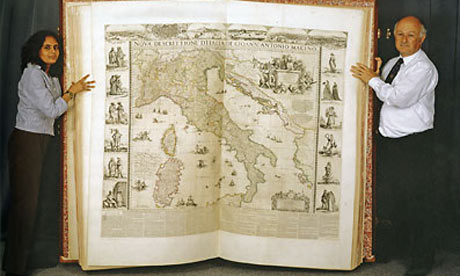
Largest book in the world goes on show for the first time | Books | The Guardian: "Largest book in the world goes on show for the first time
Klencke Atlas, which is 350 years old, will be displayed as part of British Library exhibition on maps
The Klencke Atlas has never been publicly displayed with its pages open before. Photograph: British Library
It takes six people to lift it and has been recorded as the largest book in the world, yet the splendid Klencke Atlas, presented to Charles II on his restoration and now 350 years old, has never been publicly displayed with its pages open. That glaring omission is to be rectified, it was announced by the British Library today, when it will be displayed as one of the stars of its big summer exhibition about maps.
The summer show will feature about 100 maps, considered some of the greatest in the world, with three-quarters of them going on display for the first time.
At the exhibition's core will be wall maps, many of them huge, which tell a story that is much more than geography. Many of them, said the library's head of map collections, Peter Barber: 'Hold their own with great works of art.'
He added: 'This is the first map exhibition of its type because, normally, when you think of maps you think of geography, or measurement or accuracy.'
The exhibition aims to challenge people's assumptions about maps and celebrate their magnificence, as demonstrated by the 37 maps in the Klencke Atlas, which was intended as an encyclopaedic summary of the world.
It is almost absurdly huge – 1.75 metres (5ft) tall and 1.9 metres (6ft) wide – and was given to the king by Dutch merchants and placed in his cabinet of curiosities.
'It is going to be quite a spectacle,' said Tom Harper, head of antiquarian maps. 'Even standing beside it is quite unnerving.'
As a contrast, one of the smallest maps in the world, a fingernail-sized German coin from 1773 showing a bird's eye view of Nuremberg, will be exhibited close by.
mercoledì, gennaio 20, 2010
CORSO DI STORIA DELL';INCISIONE A MILANO
CORSO DI STORIA DELL';INCISIONE A MILANO
CORSI DI AGGIORNAMENTO: TEORIA E STORIA DELLA FOTOGRAFIA - CATALOGAZIONE ARCHIVIAZIONE DELLA FOTOGRAFIA
CORSO DI AGGIORNAMENTO ; TEORIA E STORIA DELLA FOTOGRAFIA
Il Museo di Fotografia Contemporanea organizza un corso aperto a ogni tipo di pubblico.
Il corso prevede tre lezioni dedicate alla storia della fotografia e alla comprensione del linguaggio fotografico, con particolare attenzione verso i generi della fotografia e nei confronti del passaggio al digitale. Il quarto incontro e il workshop finale sono pensati specificatamente per educatori, operatori del settore e insegnanti di ogni ordine e grado.
Il corso si tiene per cinque giovedì consecutivi presso il Museo, dalle ore 18 alle 20.30, a partire da giovedì 11 febbraio 2010.
Il costo di iscrizione per le prime tre lezioni è 30 euro; per tutti e cinque gli appuntamenti è 40 euro.
Info, programma e iscrizioni nella sezione SERVIZIO EDUCATIVO/FORMAZIONE del sito www.mufoco.org
CORSO DI CATALOGAZIONE E ARCHIVIAZIONE DELLA FOTOGRAFIA
Il corso, rivolto a studenti laureati, è realizzato dal Centro Riccardo Bauer in collaborazione con il Museo, ed è alla sua terza edizione. Ha inizio il 25 gennaio e termina il 24 giugno 2010, con un totale di 300 ore di lezioni, esercitazioni di laboratorio, visite ad archivi, comprese 120 ore di stage presso archivi di musei, enti pubblici e privati, case editrici, agenzie.
Info, programma completo, modalità di iscrizione:
www.cfpbauer.it/15/09/2009/catalogazione-e-archiviazione-della-fotografia/
MUSEO DI FOTOGRAFIA CONTEMPORANEA
orari di apertura (fino al 31 gennaio 2010):
martedì - domenica ore 10 - 19
giovedì ore 10 - 23
lunedì chiuso
BIBLIOTECA
mercoledì - venerdì ore 10 - 19
sabato su appuntamento
ingresso gratuito
info:
Museo di Fotografia Contemporanea
Villa Ghirlanda, via Frova 10
20092 Cinisello Balsamo - Milano
T +39 02 6605661"
CORSI DI AGGIORNAMENTO: TEORIA E STORIA DELLA FOTOGRAFIA - CATALOGAZIONE ARCHIVIAZIONE DELLA FOTOGRAFIA
CORSO DI AGGIORNAMENTO ; TEORIA E STORIA DELLA FOTOGRAFIA
Il Museo di Fotografia Contemporanea organizza un corso aperto a ogni tipo di pubblico.
Il corso prevede tre lezioni dedicate alla storia della fotografia e alla comprensione del linguaggio fotografico, con particolare attenzione verso i generi della fotografia e nei confronti del passaggio al digitale. Il quarto incontro e il workshop finale sono pensati specificatamente per educatori, operatori del settore e insegnanti di ogni ordine e grado.
Il corso si tiene per cinque giovedì consecutivi presso il Museo, dalle ore 18 alle 20.30, a partire da giovedì 11 febbraio 2010.
Il costo di iscrizione per le prime tre lezioni è 30 euro; per tutti e cinque gli appuntamenti è 40 euro.
Info, programma e iscrizioni nella sezione SERVIZIO EDUCATIVO/FORMAZIONE del sito www.mufoco.org
CORSO DI CATALOGAZIONE E ARCHIVIAZIONE DELLA FOTOGRAFIA
Il corso, rivolto a studenti laureati, è realizzato dal Centro Riccardo Bauer in collaborazione con il Museo, ed è alla sua terza edizione. Ha inizio il 25 gennaio e termina il 24 giugno 2010, con un totale di 300 ore di lezioni, esercitazioni di laboratorio, visite ad archivi, comprese 120 ore di stage presso archivi di musei, enti pubblici e privati, case editrici, agenzie.
Info, programma completo, modalità di iscrizione:
www.cfpbauer.it/15/09/2009/catalogazione-e-archiviazione-della-fotografia/
MUSEO DI FOTOGRAFIA CONTEMPORANEA
orari di apertura (fino al 31 gennaio 2010):
martedì - domenica ore 10 - 19
giovedì ore 10 - 23
lunedì chiuso
BIBLIOTECA
mercoledì - venerdì ore 10 - 19
sabato su appuntamento
ingresso gratuito
info:
Museo di Fotografia Contemporanea
Villa Ghirlanda, via Frova 10
20092 Cinisello Balsamo - Milano
T +39 02 6605661"
venerdì, gennaio 15, 2010
Restauratori, proviamo a ricominciare - Istruzioni per l'uso
Restauratori, proviamo a ricominciare - Istruzioni per l'uso: "riprendo e pubblico da 'Biblioteche oggi' del dicembre 2009 il seguente articolo che lumeggia abbastanza bene i temi aperti ad oggi:
I restauratori col bollino blu
(come le banane)
A proposito di macchinose procedure di qualificazione e dintorni
Gisella Guasti
Responsabile del Laboratorio di restauro
Biblioteca nazionale centrale di Firenze"
https://www.bncf.firenze.sbn.it/biblioteca/laboratorio-di-restauro-conservazione-libri-manoscritti/
giovedì, gennaio 14, 2010
Il ministro Frattini in Mauritania: firmati accordi di cooperazione
Il ministro Frattini in Mauritania: firmati accordi di cooperazione: "Grazie all’iniziativa della Cooperazione italiana per la formazione di specialisti nel restauro di antichi testi manoscritti conservati nelle biblioteche private in Mauritania, in due anni sono stati realizzati cinque laboratori con attrezzature e materiali e sono stati formati dodici specialisti che potranno lavorare autonomamente per i prossimi cinque anni. Il problema, però, è che i testi presenti delle biblioteche sono oltre 40 mila e di questi nell’ambito del progetto ne sono stati salvati 20 mila. Di conseguenza, i libri rimanenti rischiano di essere distrutti in quanto mal conservati o attaccati da tarli e termiti. Da qui le autorità mauritane hanno chiesto al ministro di proseguire e, se possibile, di estendere l’iniziativa."
Passariano: testi di astronomia e coranici sottratti alle tarme dalla scuola di restauro | Blog di Aldo Rossi
Passariano: testi di astronomia e coranici sottratti alle tarme dalla scuola di restauro | Blog di Aldo Rossi: "Dal MV di oggi
«È un risultato straordinario. L’Italia prenderà seriamente in considerazione la richiesta mauritana di continuare a preservare il suo patrimonio culturale». Il ministro degli Esteri, Franco Frattini, in visita nel Paese africano, ha commentato cosí i risultati ottenuti dal progetto finanziato dalla cooperazione italiana e dalla Regione Friuli Venezia Giulia per la formazione di specialisti nel restauro di antichi testi manoscritti conservati in centinaia di biblioteche private in tante città della Mauritania.
Decine di migliaia di manoscritti in arabo classico su astronomia, matematica, letteratura, giurisprudenza e anche testi coranici, che sono a rischio di sparizione perchè mal conservati o attaccati da tarli e termiti.
Il progetto iniziato nel dicembre 2007 si è concluso formalmente oggi, ma non è escluso, come ha detto Frattini visitando ieri uno dei laboratori, che possa essere finanziato nuovamente. In due anni di lavoro sono stati realizzati 5 laboratori con attrezzature e materiali, e sono stati formati 12 specialisti mauritani che potranno lavorare autonomamente per i prossimi 5 anni. Il finanziamento è venuto dalla Farnesina per circa 600 mila euro e, per altri 350 mila euro, metà dalla Regione Friuli Venezia Giulia e metà da partner governativi mauritani. Le biblioteche, tutte private, si trovano oltre che nella capitale mauritana, in altre 4 città sparse nel deserto e considerate dall’Unesco patrimonio dell’umanità. Si tratta di Chingiuetti, Ouadane, Tichitt, Oualata, le ultime due ormai difficilmente raggiungibili attraverso le dune del deserto a causa del sempre maggior controllo del territorio dal parte di Al Qaeda."
«È un risultato straordinario. L’Italia prenderà seriamente in considerazione la richiesta mauritana di continuare a preservare il suo patrimonio culturale». Il ministro degli Esteri, Franco Frattini, in visita nel Paese africano, ha commentato cosí i risultati ottenuti dal progetto finanziato dalla cooperazione italiana e dalla Regione Friuli Venezia Giulia per la formazione di specialisti nel restauro di antichi testi manoscritti conservati in centinaia di biblioteche private in tante città della Mauritania.
Decine di migliaia di manoscritti in arabo classico su astronomia, matematica, letteratura, giurisprudenza e anche testi coranici, che sono a rischio di sparizione perchè mal conservati o attaccati da tarli e termiti.
Il progetto iniziato nel dicembre 2007 si è concluso formalmente oggi, ma non è escluso, come ha detto Frattini visitando ieri uno dei laboratori, che possa essere finanziato nuovamente. In due anni di lavoro sono stati realizzati 5 laboratori con attrezzature e materiali, e sono stati formati 12 specialisti mauritani che potranno lavorare autonomamente per i prossimi 5 anni. Il finanziamento è venuto dalla Farnesina per circa 600 mila euro e, per altri 350 mila euro, metà dalla Regione Friuli Venezia Giulia e metà da partner governativi mauritani. Le biblioteche, tutte private, si trovano oltre che nella capitale mauritana, in altre 4 città sparse nel deserto e considerate dall’Unesco patrimonio dell’umanità. Si tratta di Chingiuetti, Ouadane, Tichitt, Oualata, le ultime due ormai difficilmente raggiungibili attraverso le dune del deserto a causa del sempre maggior controllo del territorio dal parte di Al Qaeda."
giovedì, gennaio 07, 2010
Biblioteche oggi. Mensile di informazione e dibattito.
è stato pubblicato su biblioteche oggi l'articolo di Gisella Guasti sulla qualifica dei restauratori dei beni librari, purtroppo non è disponibile on line.
Biblioteche oggi. Mensile di informazione e dibattito.: "Discussione
* p. 25 I restauratori col bollino blu (come le banane)
Gisella Guasti [abstract]"
Biblioteche oggi. Mensile di informazione e dibattito.: "Discussione
* p. 25 I restauratori col bollino blu (come le banane)
Gisella Guasti [abstract]"
Trani - Biblioteca, sistemati tutti i libri | Trani Web il portale di Trani
Trani - Biblioteca, sistemati tutti i libri | Trani Web il portale di Trani: "Trani Informa
Comunicazione e informazione culturale, turistica e di servizio
Biblioteca, sistemati tutti i libri
Tempi più lunghi per l'archiviazione. Gestione a una società leccese
mercoledì 6 gennaio 2010
Duemila e 87 metri lineari di libri. Missione compiuta alla biblioteca Giovanni Bovio, dove la Premio srl di Bologna ha finito di sistemare già il mese scorso i volumi mancanti all’appello sugli scaffali, ponendo fine a un’Odissea che va avanti dal 1995. Da quando cioè la sede di Palazzo Vischi venne chiusa per problemi statici.
I libri, rimasti per anni in balìa di polvere e umidità nei depositi, erano così rovinati da richiedere un attento restauro. E così la nuova sede della biblioteca in piazza San Francesco venne inaugurata nel dicembre 2003 praticamente senza libri. Solo quattro anni dopo venne completata la sistemazione delle sale Beltrani e Trombetta con 12mila volumi tutti antichi, mentre per la maggior parte degli altri 100mila volumi mancavano scaffali adatti alla nuova struttura.
Nemmeno avere gli scaffali è stato semplice: l’azienda vincitrice dell’appalto, la Bertello di Cuneo, fallì e passarono due anni prima che si definisse l’aggiudicazione a un’altra azienda, la Seca di Trani. Ma sistemare i libri era tutta un’altra storia. Ci sono voluti due appalti per metterne 80mila: il primo a ore alla cooperativa L’Isola di Trani (25mila libri) e il secondo a metro lineare alla Premio srl di Bologna (gli altri 55mila).
Ma non è ancora finita per la Bovio. Mancano ancora il responsabile e il personale per far funzionare la struttura. Il responsabile sarà nominato dopo l’ultimo colloquio con aspiranti al ruolo; la gestione invece dovrebbe essere affidata a una società di Lecce, previa verifica della documentazione già arrivata. Questioni di giorni.
Tempi lunghi invece per l’archiviazioni informatica e l’inserimento dei volumi nel sistema Sbn (Servizio bibliotecario nazionale): persi i fondi Por per un milione di euro, perché il Comune non aveva affidato per tempo gli appalti, si cercano i soldi. Difficile prevedere la spesa nel prossimo bilancio di previsione, si spera in nuovi fondi europei."
Comunicazione e informazione culturale, turistica e di servizio
Biblioteca, sistemati tutti i libri
Tempi più lunghi per l'archiviazione. Gestione a una società leccese
mercoledì 6 gennaio 2010
Duemila e 87 metri lineari di libri. Missione compiuta alla biblioteca Giovanni Bovio, dove la Premio srl di Bologna ha finito di sistemare già il mese scorso i volumi mancanti all’appello sugli scaffali, ponendo fine a un’Odissea che va avanti dal 1995. Da quando cioè la sede di Palazzo Vischi venne chiusa per problemi statici.
I libri, rimasti per anni in balìa di polvere e umidità nei depositi, erano così rovinati da richiedere un attento restauro. E così la nuova sede della biblioteca in piazza San Francesco venne inaugurata nel dicembre 2003 praticamente senza libri. Solo quattro anni dopo venne completata la sistemazione delle sale Beltrani e Trombetta con 12mila volumi tutti antichi, mentre per la maggior parte degli altri 100mila volumi mancavano scaffali adatti alla nuova struttura.
Nemmeno avere gli scaffali è stato semplice: l’azienda vincitrice dell’appalto, la Bertello di Cuneo, fallì e passarono due anni prima che si definisse l’aggiudicazione a un’altra azienda, la Seca di Trani. Ma sistemare i libri era tutta un’altra storia. Ci sono voluti due appalti per metterne 80mila: il primo a ore alla cooperativa L’Isola di Trani (25mila libri) e il secondo a metro lineare alla Premio srl di Bologna (gli altri 55mila).
Ma non è ancora finita per la Bovio. Mancano ancora il responsabile e il personale per far funzionare la struttura. Il responsabile sarà nominato dopo l’ultimo colloquio con aspiranti al ruolo; la gestione invece dovrebbe essere affidata a una società di Lecce, previa verifica della documentazione già arrivata. Questioni di giorni.
Tempi lunghi invece per l’archiviazioni informatica e l’inserimento dei volumi nel sistema Sbn (Servizio bibliotecario nazionale): persi i fondi Por per un milione di euro, perché il Comune non aveva affidato per tempo gli appalti, si cercano i soldi. Difficile prevedere la spesa nel prossimo bilancio di previsione, si spera in nuovi fondi europei."
giovedì, dicembre 17, 2009
workshop on AN EXEMPLAR FOR STIFF-BOARD BINDING with Christopher Clarkson
Archives of the Republic of Slovenia
In collaboration with the
University of Ljubljana
Conservation Department of the Academy
of Fine Arts & Design
Announce a workshop on
AN EXEMPLAR FOR STIFF-BOARD BINDING
with
Christopher Clarkson
Ljubljana, 8-19 November 2010
Tutor: Prof. Christopher CLARKSON, Oxford, UK
Organizer: Prof. Dr. Jedert Vodopivec (Archives of Slovenia, University of Ljubljana)
Place: National Archives, Ljubljana, Slovenia
Date: 8-19 November 2010 from 8am to 5.30 pm daily except Saturday and Sunday
Working language: English
Contact e-mail: jedert.vodopivec@gov.si
Workshop costs: fee/person: 1200 Euros
accommodation & travel: is not included in the fee
Application procedure:
Applicants should complete the application form, enclose a current CV and submit a statement on how the workshop will benefit to their practice and development as book conservator.
Application Deadline: 31. January 2010
Applicants will be evaluated according to their experience and knowledge and the content of their personal statement.
Applicants will be notified of their standing in the selection procedure by end of March 2010. Each selected participant will be required to forward the seminar fee and materials costs by 15th June 2010 in order to secure the place.
In case of cancellation the organizer will retain 200 Euros.
Accommodation :
http://www.apartmaji.si/
http://www.ljubljana.si/si/turizem/nastanitev/apartmaji_in_sobe/default.html
http://www.daj-dam.si/slo/Mrak/mrakmain.htm
http://www.slovenia.info/?mladinski_dom=23314&lng=1
http://www.privodniku.si/prenocisca.html"
In collaboration with the
University of Ljubljana
Conservation Department of the Academy
of Fine Arts & Design
Announce a workshop on
AN EXEMPLAR FOR STIFF-BOARD BINDING
with
Christopher Clarkson
Ljubljana, 8-19 November 2010
Tutor: Prof. Christopher CLARKSON, Oxford, UK
Organizer: Prof. Dr. Jedert Vodopivec (Archives of Slovenia, University of Ljubljana)
Place: National Archives, Ljubljana, Slovenia
Date: 8-19 November 2010 from 8am to 5.30 pm daily except Saturday and Sunday
Working language: English
Contact e-mail: jedert.vodopivec@gov.si
Workshop costs: fee/person: 1200 Euros
accommodation & travel: is not included in the fee
Application procedure:
Applicants should complete the application form, enclose a current CV and submit a statement on how the workshop will benefit to their practice and development as book conservator.
Application Deadline: 31. January 2010
Applicants will be evaluated according to their experience and knowledge and the content of their personal statement.
Applicants will be notified of their standing in the selection procedure by end of March 2010. Each selected participant will be required to forward the seminar fee and materials costs by 15th June 2010 in order to secure the place.
In case of cancellation the organizer will retain 200 Euros.
Accommodation :
http://www.apartmaji.si/
http://www.ljubljana.si/si/turizem/nastanitev/apartmaji_in_sobe/default.html
http://www.daj-dam.si/slo/Mrak/mrakmain.htm
http://www.slovenia.info/?mladinski_dom=23314&lng=1
http://www.privodniku.si/prenocisca.html"
Ljubljana 8-19 November 2010 Workshop.
Ljubljana 8-19 November 2010 Workshop.
Title: 'AN EXEMPLAR FOR STIFF-BOARD BINDING'
Tutor: Prof. Christopher CLARKSON, Oxford, UK
Organizer: Prof. Dr. Jedert Vodopivec
Place: National Archives, Ljubljana, Slovenia
The purpose of this Workshop is not one of recreating an historical bookbinding model but of extracting the best techniques from the finest periods of Western bookbinding, seen from an engineering/mechanical perspective. In producing this model prof. C. Clarkson wants participants, through discussion, lectures & practical work, to appreciate how interrelated each part is to movements within the whole three-dimensional object.
From this model prof. Clerkson also wish to supply participants with a wide pool of information & techniques, in fact to gain a greater understanding on which to plan conservation & repair of later period stiff-board bindings. During the last day we will be studying a selection of 16 19th century damaged bindings & discussing the options we have for stabilization & repair of their structures.
An introductory lecture will cover the following:
* From where did many of the features of modern European binding derive?
* Features such as the convex spine, backing shoulders, overlapping boards?
During this session we are going to concentrate upon a binding type that Prof. Clarkson thinks of as a milestone on the way to perceiving answers to these questions. In doing this he hopes an understanding may be gained of not only historical techniques, but also of the asthetic, and qualities in techniques surrounding certain of his modern stiff-board hand binding practices.
Further background.
The manuscript period developed very diverse codex constructions that did not begin to be reduced to a few basic types of binding until the latter part of the 14th century, or even later. When the individual craftsman produced the whole bookbinding, the materials and techniques used were
usually of a high standard. In fact the object not only displayed a wholeness but a natural vitality, a spontaneity, which at first carried on into the printed book period. By 1500 A.D. we begin to see features that suggest greater division of labour, economies in quality of materials used and abbreviations in techniques.
The Workshop will concentrate on making a binding based upon the later laced board binding, which will encompass good features of construction from various types of stiff-board binding. Success will rely on well-judged sewing, board shaping, endbanding and covering, and not on artificial spine
shaping, adhesives or pressing. Care and concentration are required, because in this binding there are few of the in-built tolerances so necessary for the post c.1550 binding trade, or for that matter for today1s average bookbinder. To achieve this will be hard work but by the end of the session Prof. Clarkson hopes you will have understood some of his basic constructional philosophy and some essential techniques that will greatly help you in your future studies."
Title: 'AN EXEMPLAR FOR STIFF-BOARD BINDING'
Tutor: Prof. Christopher CLARKSON, Oxford, UK
Organizer: Prof. Dr. Jedert Vodopivec
Place: National Archives, Ljubljana, Slovenia
The purpose of this Workshop is not one of recreating an historical bookbinding model but of extracting the best techniques from the finest periods of Western bookbinding, seen from an engineering/mechanical perspective. In producing this model prof. C. Clarkson wants participants, through discussion, lectures & practical work, to appreciate how interrelated each part is to movements within the whole three-dimensional object.
From this model prof. Clerkson also wish to supply participants with a wide pool of information & techniques, in fact to gain a greater understanding on which to plan conservation & repair of later period stiff-board bindings. During the last day we will be studying a selection of 16 19th century damaged bindings & discussing the options we have for stabilization & repair of their structures.
An introductory lecture will cover the following:
* From where did many of the features of modern European binding derive?
* Features such as the convex spine, backing shoulders, overlapping boards?
During this session we are going to concentrate upon a binding type that Prof. Clarkson thinks of as a milestone on the way to perceiving answers to these questions. In doing this he hopes an understanding may be gained of not only historical techniques, but also of the asthetic, and qualities in techniques surrounding certain of his modern stiff-board hand binding practices.
Further background.
The manuscript period developed very diverse codex constructions that did not begin to be reduced to a few basic types of binding until the latter part of the 14th century, or even later. When the individual craftsman produced the whole bookbinding, the materials and techniques used were
usually of a high standard. In fact the object not only displayed a wholeness but a natural vitality, a spontaneity, which at first carried on into the printed book period. By 1500 A.D. we begin to see features that suggest greater division of labour, economies in quality of materials used and abbreviations in techniques.
The Workshop will concentrate on making a binding based upon the later laced board binding, which will encompass good features of construction from various types of stiff-board binding. Success will rely on well-judged sewing, board shaping, endbanding and covering, and not on artificial spine
shaping, adhesives or pressing. Care and concentration are required, because in this binding there are few of the in-built tolerances so necessary for the post c.1550 binding trade, or for that matter for today1s average bookbinder. To achieve this will be hard work but by the end of the session Prof. Clarkson hopes you will have understood some of his basic constructional philosophy and some essential techniques that will greatly help you in your future studies."
Iscriviti a:
Post (Atom)